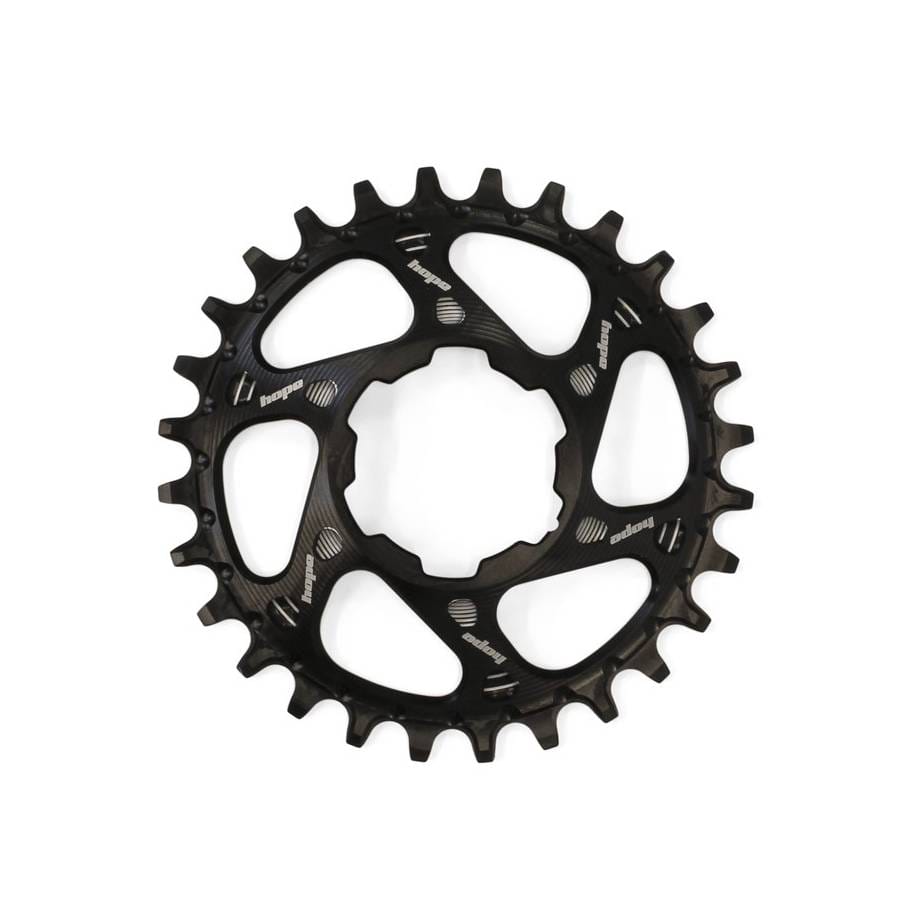
Hope Spiderless Retainer Ring Review: Chainline, Fitment, and Who Should Use It
The Hope Spiderless Retainer Ring is a direct-mount narrow-wide chainring for Hope cranksets. It is the small part that decides chainline, chain retention, tooth size, drivetrain compatibility, and whether your Hope crank can stay simple without a separate spider.
That makes it easy to underestimate. A chainring looks basic until the wrong offset, tooth count, or mounting standard turns a clean drivetrain refresh into rubbing, poor chainline, or a part that cannot be replaced with a common aftermarket ring.

Quick Verdict
The Hope Spiderless Retainer Ring makes sense if you already run Hope cranks and want a clean direct-mount chainring with proper Hope spline fit, narrow-wide retention, and standard or Boost offset options. It is the neatest route when you want the drivetrain to stay within the Hope crank ecosystem.
It is not the ring I would buy casually without checking crank generation, offset, tooth count, and drivetrain type first. The main downside is not performance. It is commitment: Hope’s direct-mount spline is not the same as SRAM, Race Face, Shimano, or other common direct-mount standards, so aftermarket choice is narrower.
Who It Is For
This chainring is mainly for riders already using Hope cranksets who want a direct-mount 1x setup without a separate spider. It suits mountain bikes, trail bikes, enduro bikes, and harder-use builds where chain retention and serviceable metal parts matter more than chasing the absolute lightest drivetrain.
It also makes sense if you are replacing a worn Hope ring and want to keep the same chainline. If your current setup shifts quietly, holds the chain well, and only needs a fresh ring, staying with the correct Hope part is usually the cleanest answer.
Key Specs
Hope lists the Spiderless Chainring as a direct-mount retainer ring for its crankset, with standard and Boost options. Current Hope specs include 9, 10, 11, and 12-speed compatibility, including SRAM T-Type and Shimano HG+, plus a 28T to 36T size range.
- Type: direct-mount 1x chainring for Hope cranksets.
- Material: CNC-machined 7075-T6 aluminium.
- Tooth profile: asymmetric narrow-wide retainer profile.
- Sizes: 28T, 30T, 32T, 34T, and 36T.
- Offsets: standard and Boost options.
- Drivetrain compatibility: 9, 10, 11, and 12-speed, including SRAM T-Type and Shimano HG+ according to Hope.
- Claimed weights: 30T 61g, 32T 64g, 34T 72g, and 36T 80g.
- Colors: black, silver, smoke, blue, red, purple, and orange.
The Important Fitment Detail
The big thing is simple: this is a Hope direct-mount ring for Hope cranksets. If you are choosing the whole crank platform, start with the Hope EVO crankset review first. Do not treat “direct mount” as a universal standard. Direct-mount chainrings can look similar from a distance, but spline shape, lockring hardware, offset, and chainline are brand-specific details.
Hope’s Evo crankset page says the crank uses a versatile spline mount for chainrings or spiderless chainrings, and it points riders toward Hope’s chainline and crank compatibility documents. That is the right way to think about this ring: crank first, mounting standard second, offset third.
If you are not sure whether your crank is the right Hope model, stop before ordering. A Hope ring is not a safe blind replacement for a SRAM direct-mount ring, Race Face Cinch ring, Shimano direct-mount ring, or another brand’s spiderless system.
Standard vs Boost Offset
The offset decision is where many riders can get caught out. Hope offers standard and Boost versions because the ring position affects chainline. The wrong offset can move the chain too far inboard or outboard, which can make the drivetrain noisier and less happy in the bigger cassette sprockets.
For most riders, the frame and rear hub spacing decide the likely direction. A non-Boost bike normally wants the standard option. A Boost 148mm rear hub setup normally points toward the Boost option. But if the bike has a non-standard crank, unusual chainline target, Super Boost rear end, or mixed parts, confirm the chainline rather than guessing from the word “Boost” alone.
Tooth Count Choice
Tooth count is not just about top speed. It changes climbing effort, cadence, chain angle, and how often you sit at the extremes of the cassette.
- 28T: useful for steep terrain, heavy bikes, loaded riding, or riders who want easier climbing.
- 30T: a good choice for technical trail riding and steeper local routes.
- 32T: the common all-round MTB choice for many 1x setups.
- 34T: better if you are strong, ride faster trails, or often spin out smaller rings.
- 36T: more niche, usually for strong riders, smoother terrain, or bikes where climbing range is already generous.
If you are replacing a worn ring and liked the gearing, stay with the same tooth count. If climbing always feels too hard, drop two teeth. If you regularly spin out and barely use the easiest gears, go up two teeth.
Chain Retention And Tooth Profile
Hope describes the current tooth profile as asymmetric and says it is designed for cross-compatibility with modern drivetrains, better mud shedding, improved retention, and better performance at extreme chain angles. In plain terms, the ring is meant to hold the chain well without needing a guide on normal 1x bikes.
That does not mean a chain guide is useless. Riders who race downhill, ride bike-park laps, or hit rough terrain at speed may still want upper retention. But for normal trail and enduro use, a fresh narrow-wide ring, a clutch derailleur, and a correctly sized chain are usually the first things to get right.
What Riders Actually Run Into
The most useful rider feedback is not a long list of glowing star ratings. It is the practical stuff people ask when they are stuck. In a Vital MTB forum thread about Hope crank spline alternatives, one rider says they were struggling to find non-Hope direct-mount chainring options, especially in Boost, 32T, and plain colors. That lines up with the biggest buying caution here: the Hope setup is clean, but it is not the most open ecosystem.
There is also a tool and lockring concern. In a r/bikewrench discussion about changing a Hope spiderless chainring, the rider’s issue was not whether the chainring was good. It was whether the correct Hope tool or bottom-bracket-style tool interface was needed to remove the lockring. That is exactly the kind of detail worth checking before planning a quick five-minute swap.
So the real-world warning is not “avoid it.” The warning is: buy the right offset, make sure you have the correct removal/fitting tool path, and understand that if you want lots of third-party chainring choices, Hope’s spline is more limiting than SRAM or Race Face ecosystems.
Install Notes
Before removing the old ring, take a photo of the existing chainline and ring orientation. It sounds basic, but it makes the reinstall easier if you are replacing like for like.
- Confirm the crank model and ring type before ordering.
- Choose standard or Boost offset based on the frame and chainline target.
- Check whether you need Hope’s specific lockring or fitting tool.
- Inspect the old chain and cassette before fitting a fresh ring.
- Do not reuse a badly stretched chain on a new ring.
- After fitting, check chainline in the largest and smallest cassette sprockets.
If the drivetrain is noisy after installation, do not immediately blame the ring. Check chain wear, chain length, derailleur clutch condition, B-tension, ring offset, and whether the chain is compatible with the tooth profile.
Pros
- Clean direct-mount setup for Hope cranksets.
- Standard and Boost options for chainline matching.
- Modern 9 to 12-speed compatibility according to Hope.
- Works with current SRAM T-Type and Shimano HG+ per Hope’s product page.
- Good tooth-size spread from 28T to 36T.
- Replaceable wear item that keeps a Hope crank in service.
- Multiple anodized color options.
Cons
- Only makes sense for compatible Hope cranksets.
- Aftermarket ring choice is narrower than with SRAM or Race Face direct-mount systems.
- Wrong offset can create poor chainline.
- You may need a specific tool or lockring approach for removal and installation.
- Not the cheapest way to buy a replacement chainring.
Who Should Skip It
Skip it if you are not using Hope cranks, unless you have confirmed the exact mounting standard with a mechanic or Hope documentation. Also skip it if you want the widest possible aftermarket chainring choice. In that case, a crank system with more third-party ring support may suit you better.
I would also pause if you are trying to fix a noisy drivetrain and have not checked chain wear. A fresh chainring can help a worn drivetrain, but it will not rescue a stretched chain, hooked cassette teeth, or an offset mismatch.
Alternatives To Consider
If you already own Hope cranks, the closest alternative is not really another brand’s direct-mount ring. It is Hope’s spider-and-BCD route, if your crank and setup support it, or a different Hope ring size/offset. If you are building from scratch and want easier ring availability from many brands, compare the whole crank ecosystem before buying the crank, not after.
For riders who want oval rings, unusual tooth counts, or very specific colors that Hope does not currently have in stock, availability may be the deciding factor. That was the exact frustration raised in the Vital MTB discussion: the rider liked Hope’s machining, but wanted more options when a common size and color were hard to find.
FAQ
Does the Hope Spiderless Retainer Ring fit SRAM direct-mount cranks?
No. It is made for compatible Hope cranksets. Do not buy it for SRAM, Race Face, Shimano, or other direct-mount cranks unless a manufacturer-approved adapter or compatibility document says otherwise.
Should I choose standard or Boost offset?
Choose the offset that gives the correct chainline for your frame and rear hub spacing. Non-Boost bikes usually point toward standard offset, while Boost 148mm bikes usually point toward the Boost option, but mixed setups should be checked directly.
Is 32T the best size?
32T is the safe middle ground for many mountain bikes. Choose 30T or 28T for easier climbing, and 34T or 36T if you ride faster terrain and have enough climbing range.
Can I fit it without a special tool?
Check the lockring and Hope instructions before starting. Some riders run into tool confusion when changing Hope spiderless rings, so confirm the tool before taking the bike apart.
Is it worth it?
Yes, if you have Hope cranks and want the correct direct-mount ring with clean chainline and Hope’s tooth profile. No, if you are shopping mainly on price or want a ring standard with lots of third-party options.