Hope Pro 5 hubs make the strongest case in a new wheel build: they cut the standard rear hub’s engagement gap from the Pro 4’s 8.18 degrees to 3.33 degrees while revising the seal, pawls, springs and axle architecture. That generational change matters when ratcheting through technical terrain; it matters far less when a sound Pro 4 wheel already fits, runs smoothly and gives enough pickup.
The useful decision is therefore not simply “old versus new.” It is whether Pro 5 solves a specific engagement, fitment or service problem worth the cost of a hub and wheel build. This comparison uses Hope’s current product documents and versioned service drawings alongside clearly attributed long-term tests and owner reports; HometownBikes has not ride-tested these hubs.
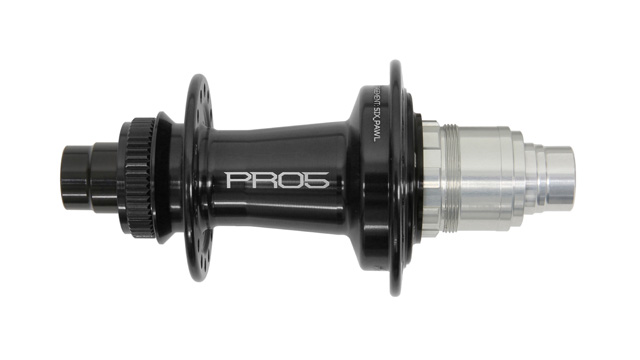
What actually changed inside the rear hub?
Pro 4
- 44 engagement points
- About 8.18° between engagement points
- Four-pawl freehub assembly
- Generation listed by Hope as 2016–2023
- Best value when you already own a healthy wheel
Pro 5
- 108 engagement points on the standard freehub
- About 3.33° between engagement points
- Six offset pawls, phased to create the 108 points
- Revised seals, pawls, springs and stepped axle
- Best default for a new wheel build
The numbers come from Hope’s current Pro 5 148 mm Boost product specification. Converting points of engagement into crank angle makes the difference easier to understand: 360 ÷ 44 is 8.18 degrees, while 360 ÷ 108 is 3.33 degrees. The Pro 5 therefore takes up drive after roughly 4.85 degrees less crank movement.
That difference is most useful when you cannot make a full pedal stroke: ratcheting through rocks, restarting on a steep pitch, balancing before a ledge or correcting pedal position through a tight turn. It adds less on fast descents and smooth terrain, where the hub spends more time coasting or continuously driven. Faster engagement can feel sharper; it does not automatically make the wheel faster.
Hope also claims reduced drag, improved sealing, wider and stronger pawl springs, wire-cut high-strength steel pawls, and a stepped axle intended to make the freehub stiffer and more durable. Those are manufacturer design claims, not evidence that every Pro 5 will outlast every Pro 4. The practical gain is that Pro 5 combines faster pickup with a redesigned sealing and drive system instead of reaching 108 points by changing only the tooth count.
Fitment decides the purchase before engagement does
“Pro 4” and “Pro 5” are families, not enough information to order a hub or spare. Before comparing prices, write down the rear spacing and axle, freehub standard, rotor interface, spoke count and intended use. If any one is unknown, stop: a good deal on the wrong shell cannot be corrected with an end cap.
- Frame spacing and axle: identify the actual standard, such as 135 mm, 142×12, 148×12 Boost or 157×12 Super Boost. End caps can convert only combinations that Hope explicitly supports; they cannot move flange geometry or turn every shell into every spacing.
- Cassette interface: confirm Shimano HG, Micro Spline, SRAM XD/XDR or the relevant e-bike body. Do not order by cassette speed alone.
- Rotor mount: Pro 5 is sold in 6-bolt and Centre Lock forms. That choice is built into the hub shell.
- Spoke drilling and wheel: Hope lists Pro 5 in 24, 28, 32 and 36 holes. A hub swap normally means a new wheel build; flange dimensions may also change spoke length.
- Standard or e-bike drive: Hope’s document library distinguishes the 108-point standard bodies from 54-point e-bike bodies. Match the diagram to the exact body rather than transferring standard-hub advice to the e-bike version.
Hope’s current hub conversion chart makes another important distinction: the rear conversion kit numbers differ between Pro 5 and Pro 4. For example, Hope lists Pro 5 6-bolt X12 kits as HUB269 for Micro Spline and HUB259 for Shimano/XD, while the Pro 4/Pro 2 Evo X12 kit is HUB242. That is a concrete reason not to buy “Hope end caps” without the generation and freehub type.
Standard Pro 5 and e-bike Pro 5 are not the same decision
The standard Pro 5 uses offset pawl timing to deliver 108 engagement points. Hope’s current document index separately labels Micro Spline, Shimano and SRAM XD e-bike freehubs as 54 POE, while the corresponding standard versions are labelled 108 POE. Hope also describes an e-bike-specific hub designed for e-bike loads.
The buying rule is simple: for a non-assisted bike, choose the standard configuration that matches the cassette, axle and rotor. For an eMTB, use Hope’s e-bike-specific configuration rather than choosing the standard body merely because 108 is the larger number. The lower 54-point figure is a deliberate part of a different load-handling design, not an inferior version accidentally missing engagement.
Sound: the newer hub may be quieter than you expect
Hope’s click has become part of the brand, but sound is a poor specification. Pawl timing, spring choice, lubricant, service condition, wheel construction and even tyre noise change what reaches the rider. Pro 5 should not be bought on the assumption that it reproduces the sharper Pro 4 buzz.
That is borne out by owner reports. In a Pinkbike discussion comparing Pro 5 sound with Pro 4, the original poster found a new Pro 5 unexpectedly quiet. Other owners in the same thread described it as softer than Pro 4 but praised its free-spinning feel and engagement after more than a year of use. A separate Reddit discussion about silencing Pro 5 contains the same generation-to-generation observation: riders moving from Pro 4 often found Pro 5 noticeably quieter.
Those reports establish variation, not a guaranteed decibel level. They are useful because they correct a buying misconception: quick engagement and loud coasting are separate characteristics. Choose fitment and mechanism first. If audible warning on shared paths matters, use a bell rather than treating hub noise as safety equipment.
Service parts are generation-specific
Both hubs are rebuildable, but their internal parts are not interchangeable sets. Hope’s official Pro 4 148 mm exploded drawing identifies a four-pawl set as HUB535, a four-spring set as HUB515, two S6903 hub bearings, and separate 17×28×7 freehub bearings. The same drawing is issue 001 dated November 2015 and belongs to the Pro 4 148 rear hub—not to Pro 5.
The official rear hub service-tool chart, issue 001 dated October 2017, lists HTT182 as the Pro 4 Shimano main/freehub bearing tool and HTT1003-06S as the seal tool; XD uses HTT182 for the main bearing and HTT187 for the freehub bearing. Those identifiers are useful only for the Pro 4 configurations named in that document.
For Pro 5, use Hope’s separate Pro 5 bearing-tools chart and the exploded drawing for the exact shell and freehub. The Hope hub document index currently separates 135, 148 Boost, 150, 157 Super Boost, Centre Lock, 6-bolt, standard, e-bike, DH and Trials versions. That version split is the service instruction: identify the assembly first, then select parts and tools from its drawing.
No universal hub torque figure is printed in the cited Pro 4 or Pro 5 exploded drawings, so one is not invented here. Cassette lockring, rotor and thru-axle torque belong to their respective cassette, rotor and frame/fork instructions. Bearing work depends on controlled support and the correct drifts, not tightening a hub to one made-up Newton-metre value.
Reliability reports need diagnosis, not vote counting
Forum searches surface both long-term satisfaction and failures. A MTBR thread about multiple Pro 4 and Pro 5 failures is relevant because it prevents a blanket “bombproof” claim. But a thread cannot establish a failure rate: it has no denominator, and posts can mix generations, freehub bodies, maintenance histories and e-bike loads.
Use those reports diagnostically. Before buying used, check for rough bearings, lateral play, damaged cassette splines, intermittent pickup, cracked flanges, corrosion beneath seals and unavailable conversion parts. Before replacing an existing Pro 4, price the actual fault—bearings, freehub assembly, rim and labour—against a complete Pro 5 wheel build. A worn freehub in an otherwise valuable wheel is a repair question; a tired hub inside a worn rim is a replacement question.
When to upgrade, keep or buy used
Choose Pro 5
- You are paying for a new wheel build anyway.
- You regularly ratchet the cranks through technical terrain.
- You need a current cassette or rotor configuration.
- You have confirmed the exact standard or e-bike version.
Keep or buy Pro 4
- Your existing wheel is straight, compatible and mechanically healthy.
- The used price leaves room for bearings or a freehub service.
- An 8.2° pickup angle is adequate for your riding.
- The exact conversion and replacement parts remain available.
Do not upgrade a healthy Pro 4 solely to gain 4.85 degrees of pickup. Do choose Pro 5 when a new build is already justified and that quicker response, revised sealing and current configuration support matter to you. If the purchase is for an e-bike, downhill or Trials build, leave the generic comparison at this point and select from Hope’s application-specific documents; those versions intentionally use different drive arrangements.
The defensible verdict is therefore conditional. Pro 5 is the better new-hub choice for most current mountain-bike builds. Pro 4 remains the better financial choice when it is already in a good wheel and meets the bike’s standards. The expensive mistake is neither model—it is ordering before identifying the shell, axle, rotor, driver and use case.