GEAR REVIEW

Hope Pedal Pins and Service Guide: F22, F20, Union Bearings, Bushings, and Rebuild Parts

HOMETOWN • HomeTown Bikes • July 16, 2026

Hope pedals are not cheap throwaway parts, so the service question matters. Pins get rounded or torn up by rocks. Bearings can feel rough after wet riding. Bushings, seals, and small hardware can decide whether a pedal still feels tight or starts to feel tired.

This guide covers the practical service logic for Hope F22, older F20 context, and Union clipless pedals. It is not a replacement for Hope’s own instructions or a mechanic’s inspection, but it should help you understand what usually needs attention before buying pins, bearings, or a service kit.

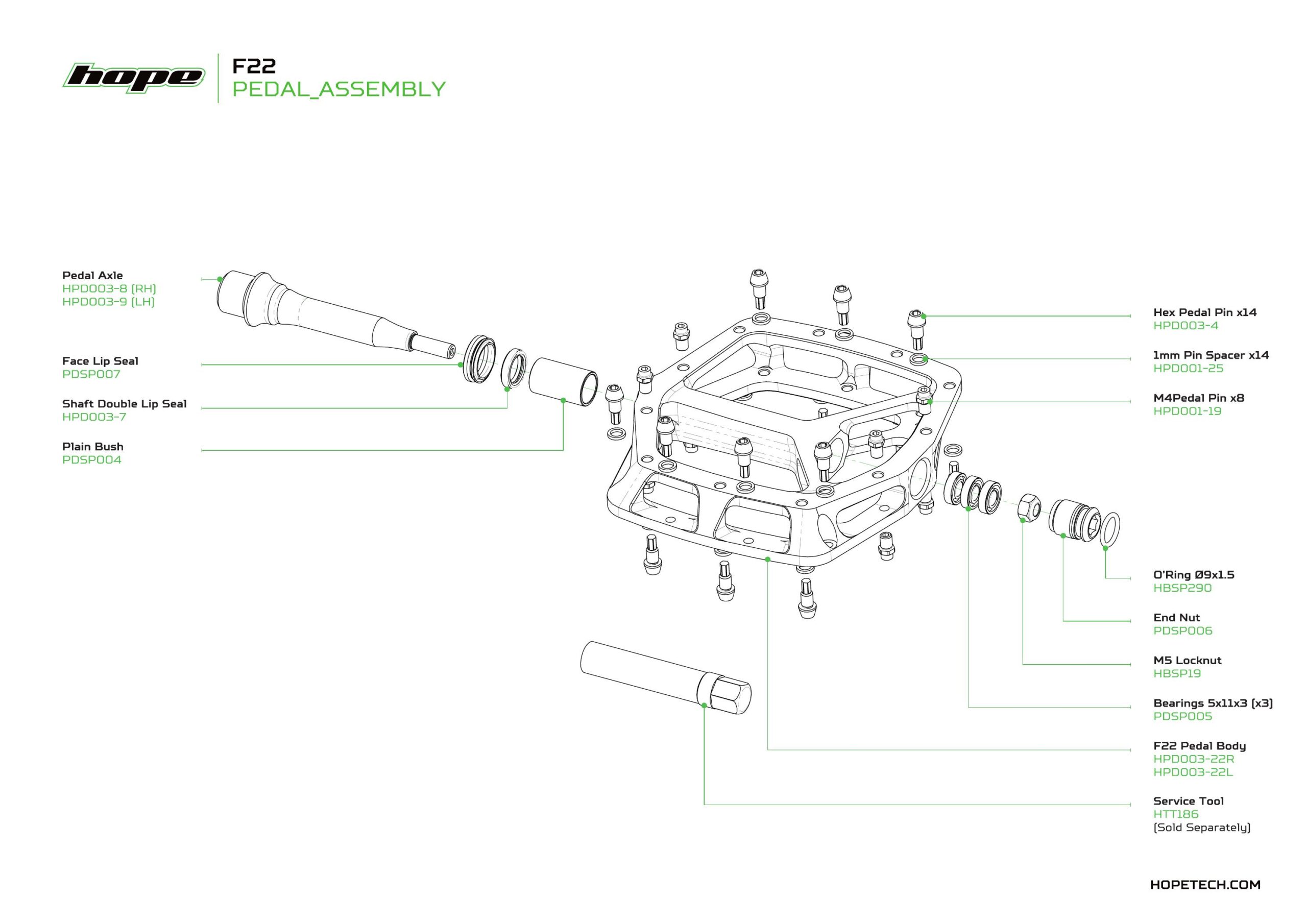
Hope F22 pedal exploded service diagram showing pins bearings seals bush axle and service tool
Hope’s F22 exploded diagram shows why serviceability is a real part of the product: pins, seals, bush, bearings, axle hardware, and a specific service tool are all identifiable parts.

Quick Verdict

Service Hope pedals when the body is still sound but the small parts are wearing: rough rotation, side play, missing pins, rounded pins, damaged seals, or a dry/loose feel around the axle. Replace the pedal only when the body, axle, thread, or clip mechanism is damaged enough that small parts no longer solve the problem.

For F22 flat pedals, Hope’s F22 product page confirms the key service story: reverse-loading pins, three cartridge bearings, an IGUS bush, internal and external sealing, and a fully serviceable rebuildable layout. For Union clipless pedals, Hope’s Union launch notes list replaceable pins on TC and GC models, three cartridge bearings, a norglide bush, and fully serviceable rebuildable construction.

What Usually Wears First

Part What you notice Common action
Pins Less grip, rounded pin heads, missing pins, damaged exposed ends Replace damaged pins or tune pin height where the pedal design allows
Bearings Rough spinning, gritty feel, notchiness, noise Refresh bearings if the pedal body and axle are still good
Bush Side play or a loose feel near the inner side of the pedal Replace as part of a service kit when worn
Seals and O-rings Water/dirt ingress, repeat bearing contamination Replace during a proper rebuild, not after the new bearings are already contaminated
Axle or body Bent axle, damaged threads, cracked or heavily gouged body Inspect carefully; replacement may be smarter than servicing small parts

The mistake is servicing only the most obvious part. If the pedal is gritty because water got past a tired seal, changing bearings without checking seals can shorten the next service interval.

F22 Pin Setup and Replacement

The F22 pin system is one of the practical reasons the newer pedal matters. Hope says the F22 uses longer adjustable pins with a hex-shaped face, shorter pins toward the center to help the concave feel, and reverse-loading pins so there is less chance of a damaged outer face stopping removal.

That reverse-loading design is useful for real mountain-bike use. Flat-pedal pins hit rocks, roots, concrete edges, and shoes. If a pin is loaded from the back of the pedal, the exposed end can be damaged without automatically trapping the pin in place.

Do not treat maximum pin height as automatically better. More pin bite can feel secure with the right shoe, but it can also make foot repositioning harder and chew shoe soles faster. In a rider discussion comparing F22 with other premium flat pedals, the useful theme is that grip depends on shoe rubber, pin feel, and platform preference together, not the pedal name alone.

F22 Bearings, Bush, and Seals

The F22 keeps the serviceable internal idea from the older F20. Hope lists three cartridge bearings and an IGUS bush, plus internal and external sealing. The official F22 exploded diagram shows the service layout clearly: pedal axle, face lip seal, shaft double lip seal, plain bush, three 5x11x3 bearings, O-ring, end nut, M5 locknut, pins, spacers, and service tool HTT186.

That does not mean every rider should open the pedal immediately. It means the part can be inspected and refreshed by someone with the correct tools and patience. If the pedal spins smoothly, has no play, and the pins are fine, leave it alone and keep riding.

Union TC and GC Pins

Union RC is the smaller clipless pedal and does not use the same pin-support idea as the bigger models. Union TC and GC are the models where pins matter. Hope says TC uses 4 pins per side for added shoe-sole contact, while GC can use 7 pins per side or foot plates for maximum shoe/pedal contact.

That makes TC and GC more tunable, but also more setup-sensitive. If the pins are too aggressive for your shoe sole and cleat position, entry and release can feel worse. If they are too low or missing, the extra platform support may not feel like much.

Rider feedback reflects that setup issue. In a Union TC/GC owner discussion, pin setup and cleat hardware come up as practical details. Treat that as anecdotal, but it is a useful reminder that clipless pedal feel is a shoe, cleat, and pedal system.

Union Bearings and Bushings

The Union range also uses three cartridge bearings and a norglide bush according to Hope’s launch notes. That puts the service logic close to F22: the pedal is designed around replaceable wear parts rather than being disposable.

Be careful with the word service, though. Bearing and axle service is not the same as rebuilding every part of a clipless mechanism. If the clip mechanism is damaged, sticky, or unsafe, use Hope’s official support route or a qualified mechanic rather than treating it like a simple pin swap.

When a Service Kit Makes Sense

A service kit makes sense when the pedal body and axle are worth keeping. Typical reasons are rough bearings, water ingress, worn bush feel, or seals that should be refreshed during a bearing job.

It makes less sense when the pedal body is badly damaged, the axle is bent, the threads are compromised, or a clipless mechanism no longer holds or releases safely. In those cases, the safest answer may be replacement or professional inspection.

When Pins Alone Are Enough

Pins alone are enough when the pedal spins well and feels tight, but the grip has dropped because pins are missing, rounded, bent, or set too low. That is a normal maintenance case for flat pedals and for pinned clipless platforms like Union TC and GC.

Before replacing every pin, check whether the shoe is part of the problem. Hard casual soles, worn flat-pedal shoes, and tread interference can all make a good pedal feel worse than it is.

When to Stop and Ask a Mechanic

Stop and ask a mechanic if the pedal axle is bent, the pedal body is cracked, the pedal threads are damaged, the bearing bore looks worn, or the clipless mechanism does not release predictably. Pedals are contact points, and a failure here can be more than annoying.

Also stop if you do not have the correct service tool. The F22 exploded diagram lists Hope service tool HTT186. Improvised tools can damage small hardware and turn a simple service into a replacement job.

Related HometownBikes Reading

For the product choice side, read Are Hope pedals good?. For the current flat-pedal review, read the Hope F22 pedals review. If you are deciding whether to keep older pedals or move to the newer body, read Hope F22 vs F20 pedals. For clipless model selection, read the Hope Union pedals guide.

Bottom Line

Hope pedal service is worth understanding because the pedals are built around replaceable small parts. F22 pin and bearing service can keep a good flat pedal alive. Union TC and GC pin setup can change how the shoe feels on the pedal. Bearings, bushings, seals, and hardware matter because they decide whether the pedal still feels precise.

Service the pedal when the main structure is good and the wear parts are the problem. Replace or get professional help when the body, axle, threads, or clip mechanism is the problem.

FAQ

Are Hope F22 pedals serviceable?

Yes. Hope lists the F22 as fully serviceable and rebuildable, with three cartridge bearings, an IGUS bush, internal and external sealing, and replaceable pins.

Do Hope F22 pedals use reverse-loading pins?

Yes. Hope says the F22 uses reverse-loading pins, which reduces the chance that a damaged outer pin face prevents removal.

Can I replace only the pins on Hope pedals?

Yes, if the pedal body, axle, bearings, bush, and seals are still healthy. Pins are the right repair when the main problem is grip loss from damaged or missing pins.

Do Hope Union pedals have replaceable pins?

Union TC and GC use replaceable pins. Union TC uses 4 pins per side, while Union GC can use 7 pins per side or foot plates for more shoe contact.

Do Hope F22 and Union pedals use the same service kit?

Many retailers list a combined F22/Union service kit, but always confirm the exact kit, model, and quantity before ordering. Do not assume an old F20 kit, F22 kit, and Union kit are interchangeable without checking the part listing.

Should I rebuild or replace worn Hope pedals?

Rebuild if the body and axle are good and the problem is bearings, bushings, seals, or pins. Replace or get mechanic support if the body is cracked, axle is bent, threads are damaged, or a clipless mechanism is unsafe.