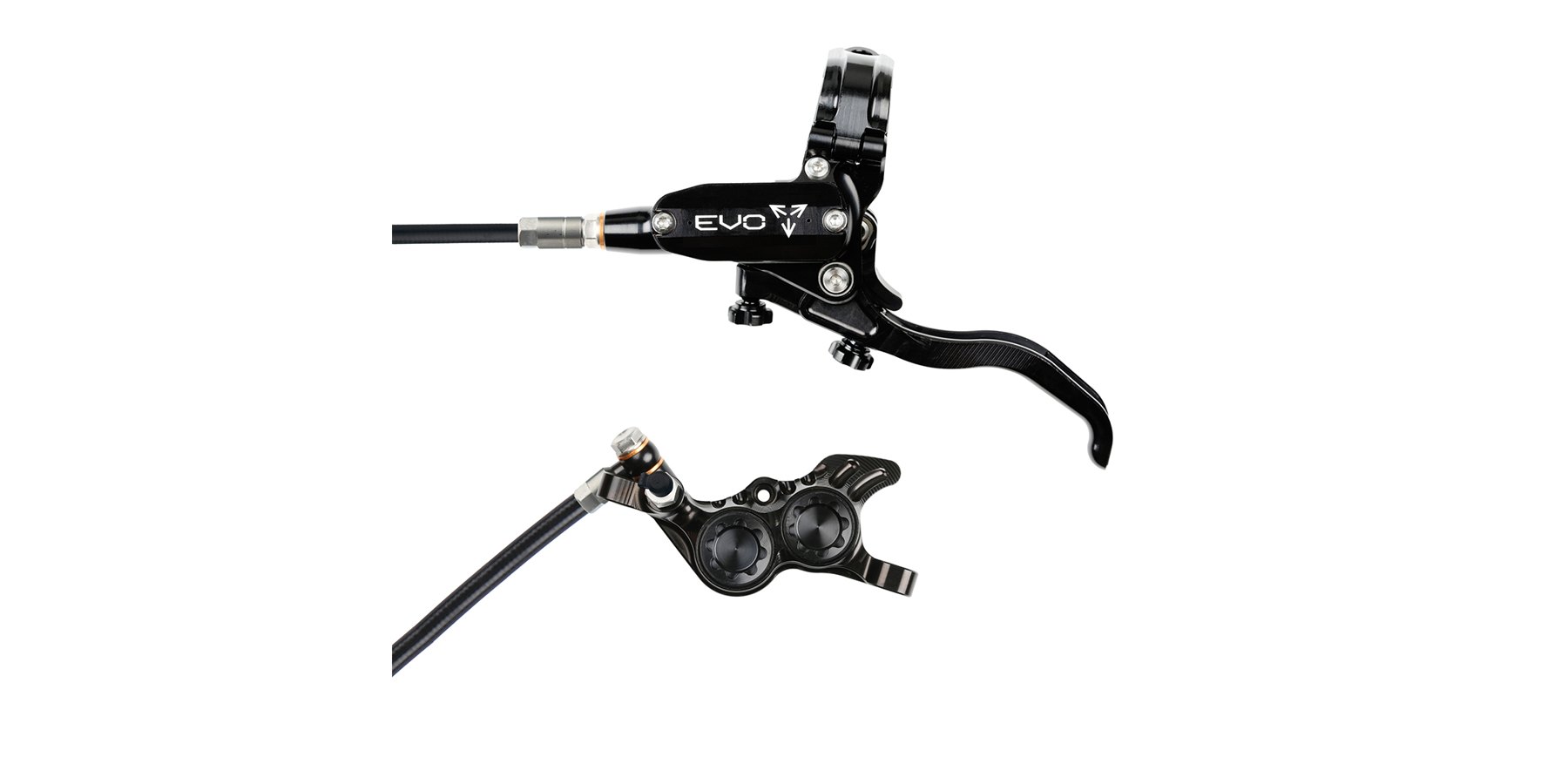
New GR4 or discounted Tech 4 V4?
The EVO GR4 is the straightforward choice when you are buying a new Hope gravity brake at similar money. It is the current-generation package, while the Tech 4 V4 still makes a strong case when it is substantially cheaper or already fitted to your bike.
The exception is a build centred on Hope's 3.3 mm vented rotor: that disc is designed specifically for V4, and Hope says the GR4 is not compatible with it. That compatibility split is more useful than declaring one brake universally best. The lighter-duty E4 belongs in a different comparison; for gravity-focused riders choosing between these two, the real decision is new EVO refinements versus V4 value and vented-rotor support.
For a complete new build, price the lever, caliper, hose, rotor and adaptor together before deciding that a discounted V4 is automatically cheaper. For an existing V4 bike, reverse the calculation: count the compatible parts and spares you can retain, then ask whether the GR4's shorter free stroke and easier service access are worth replacing them. That whole-system comparison prevents a small caliper-price difference from hiding the real conversion cost.
Problems to rule out before replacing a V4
Reports of wandering bite point, noise or inconsistent feel need a setup check before they become a verdict on the Tech 4 V4. Hope's own braking guidance puts pad condition, rotor size, bedding-in and tyre grip ahead of simply choosing the most powerful caliper. Lever feel also depends on bleed quality, pad compound, wheel size and frame or fork clearance.
If a V4 already has the power you need, service it methodically before spending on GR4: inspect pad contamination and wear, confirm the rotor is suitable and straight, bed the pads correctly, then verify the bleed and lever adjustments. An upgrade cannot compensate for a contaminated friction pair or a poor bleed.
Run those checks in that order because each one changes the evidence you get from the next test. Freshly cleaned or replaced pads need correct bedding before lever feel and outright power can be judged, while a larger rotor changes leverage and heat capacity without changing the caliper. Only compare V4 with GR4 after the current system produces repeatable bite and the tyres have enough grip to use it.
What changed from V4 to GR4
Hope describes EVO as a refinement of Tech 4 and gives the GR4 the largest pistons in the EVO range. The practical package includes revised lever ergonomics, a shorter free stroke and a master-cylinder bleed port, while the GR4 caliper gives up compatibility with the V4-only vented rotor.
For someone starting from scratch, those changes favour GR4 when prices are close. For an existing Tech 4 V4 owner, they are reasons to upgrade only if quicker pad contact, the new lever choices or the revised bleed process solve a problem you actually have. Owners using both generations repeatedly describe the V4 as powerful enough to keep, especially when replacing it would also mean abandoning expensive vented rotors.
The upgrade case is therefore strongest for a rider who dislikes the V4's pad-contact timing, wants one of the EVO blade positions, or regularly services several bikes and values the revised bleed arrangement. It is weakest when the existing V4 is reliable, its lever shape suits the rider and the bike already uses the dedicated vented discs. In that situation, spend first on fresh pads, rotor condition and a careful bleed rather than treating the newer model name as the fix.
Caliper design, power and lever feel
The GR4 remains a four-piston gravity brake, but the EVO system changes more than the caliper badge. Flow Mountain Bike's GR4 test highlights three lever blades: Control for a blade position closer to the bar, Standard for a balance of feel and adjustment, and Power for more mechanical leverage.
Public owner comparisons describe GR4 as having quicker pad contact while retaining the familiar light, progressive Hope lever feel. Owner reports are not unanimous: some notice a quicker bite and slightly more power, while others find the difference too small to justify replacing a healthy V4. Treat lever feel as a configuration choice, not a fixed product score.
Complete-system price, weight and model choice
Compare the price of a complete front-and-rear conversion, not one bare brake. A GR4 conversion may include new rotors, mounts, hoses or bleed equipment, while a V4 owner may already have compatible hardware and spares. Weight comparisons are equally configuration-sensitive because hose length, rotor size, mount and lever blade can change the finished total.
Within Hope's range, GR4 is the gravity-focused EVO option; TR4 targets a different balance, and X2 covers lighter-duty applications. That means the useful comparison is not simply the lowest gram or price figure: it is whether the selected model, lever and rotor package suit the bike and terrain.
In a Reddit comparison from an owner using both generations, the GR4 was described as biting sooner and being easier to bleed, but the Tech 4 V4 was still considered very powerful and especially attractive when discounted. A rider in the Singletrack World lever discussion similarly said setup and price controlled the choice and indicated that the V4 would have stayed on the bike without a favourable GR4 deal. These owner reports make the price gap part of the product comparison: GR4's service and contact-point changes carry more weight when the two systems cost roughly the same, while a discounted V4 can remain the stronger complete-system value.
Lever choice and exact service requirements
The lever blade changes reach and leverage, but the service difference is concrete. Use the row for the brake actually fitted; the GR4 and Tech 4 instructions are not interchangeable.
EVO GR4 service setup
Fluid: DOT 5.1
Tools: EVO bleed funnel and adaptor, relevant bleed block or old pads, T10 Torx driver, 8 mm spanner, clear drain hose, waste container and flat-blade screwdriver.
Torque: bleed nipple 8 N·m; master-cylinder bleed-port screw 3 N·m.
Tech 4 V4 service setup
Fluid: DOT 5.1 or DOT 4
Tools: Easy Bleed funnel, relevant bleed block or old pads, 8 mm spanner, clear drain hose, waste container and flat-blade screwdriver.
Torque: bleed nipple 8 N·m; reservoir-lid M3 screws 1 N·m.
For both systems: Hope recommends gloves and eye protection.
These figures come from Hope’s current 2026 EVO bleed instructions and 2025 Tech 4 bleed instructions. Hope’s Tech 4 sheet also says to bleed after shortening a hose. Neither bleed sheet publishes a hose-fitting torque, so this article does not invent one. Caliper mounting depends on the mount or adaptor configuration; confirm that against Hope’s current brake-mount documentation and the frame or fork specification.
GR4 gives direct access through the master-cylinder bleed port, while Tech 4 V4 uses the reservoir arrangement described in its own sheet. Do not transfer the GR4’s 3 N·m bleed-port value to the Tech 4 reservoir lid, or the Tech 4’s 1 N·m lid-screw value to GR4.
Rotor and brake pad compatibility
Do not order either brake from the caliper name alone. Confirm rotor diameter and thickness, mount or adaptor, frame and fork clearance, hose route, lever blade and pad compound as one system. Hope explicitly excludes GR4 from its vented-rotor compatibility and specifies that the 3.3 mm vented disc is for V4.
For a fresh gravity build using conventional compatible rotors, EVO GR4 is the cleaner current-generation choice. For a working Tech 4 V4 system—especially one already using Hope vented rotors—the financially sensible move is usually to keep it until the GR4's lever or bleed changes solve a specific problem. That conditional choice is the real GR4-versus-V4 answer.
A Reddit EVO GR4 owner discussion shows why this compatibility point changes the upgrade decision: some owners say the GR4's stiffer caliper is worth losing the 3.3 mm vented-rotor option, while others see no compelling reason to replace a recent V4 and its compatible discs. That disagreement belongs in the rotor decision because the upgrade can change the surrounding friction hardware, not merely the lever and caliper.
Before checkout, write down the front and rear rotor diameters, rotor thickness, hub interface, caliper mounts and adaptor sizes already on the bike. Then confirm hose length and routing, frame and fork clearance, preferred blade and pad compound against the exact brake configuration being ordered. Check both ends of the bike separately because front and rear hardware may differ. This catches the expensive incompatibilities before the old system is removed and makes the final price comparison honest.