GEAR REVIEW

Hope E4 Brakes Guide: XCR Pro E4, Tech 4 E4 Searches, and V4 Comparison

HOMETOWN • HomeTown Bikes • July 13, 2026

Hope E4 brakes can be confusing to shop for in 2026 because the name has been used around more than one Hope setup. Older Tech 4 E4 searches still exist, but Hope’s current brake range now shows the lightweight XCR Pro E4 as the active E4-family brake, while EVO TR4, EVO GR4, and Tech 4 V4 cover other trail and gravity jobs.

The short version: E4 is the lighter four-piston Hope option for trail, downcountry, and all-mountain riders who want control without jumping straight to V4-level heat capacity. It makes the most sense when the bike is not a downhill bike, not a heavy e-bike, and not constantly cooking brakes on long descents.

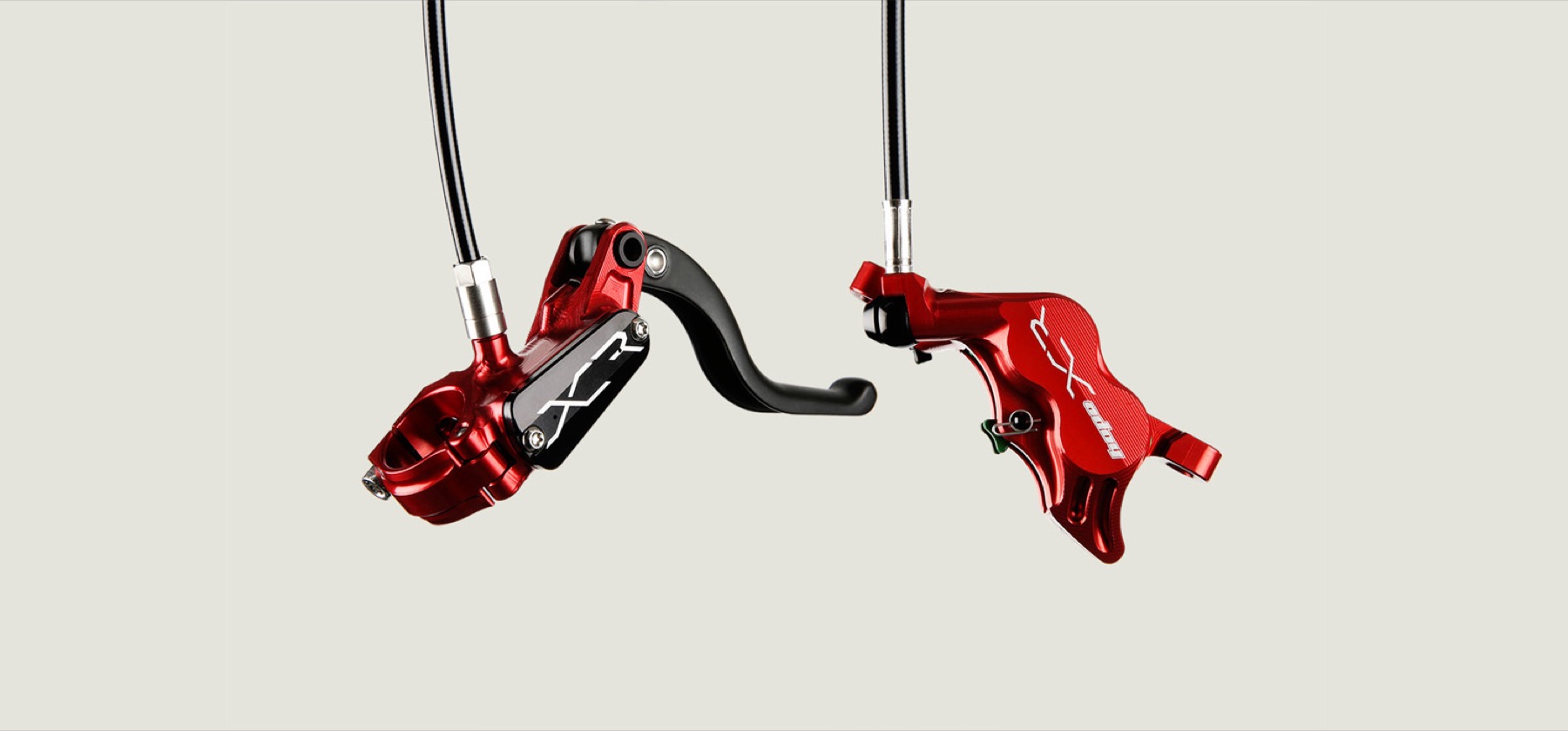
Hope XCR Pro E4 brake with red XCR Pro lever and red E4 caliper
Hope’s current XCR Pro E4 pairs a lightweight XCR Pro lever with an E4 post-mount caliper. Treat it as the current E4-family option, not as a direct replacement for every older Tech 4 E4 setup.

Quick verdict

Choose a Hope E4-style brake if you want a controlled, lighter four-piston setup for trail or downcountry riding and you are not regularly overheating bigger brakes. Choose Tech 4 V4, EVO GR4, or another heavier-duty brake if the bike is used for enduro, park laps, e-bike riding, heavier rider-and-bike loads, or very long steep descents.

What E4 means in the Hope range

The useful way to think about E4 is not “the strongest Hope brake.” It is the middle ground: more caliper than an X2-style two-piston brake, less gravity-focused than a V4. Hope’s current XCR Pro E4 page describes a carbon-blade, titanium-hardware XCR Pro lever combined with an E4 caliper for a lighter trail and downcountry brake.

That matters because the E4 name is attached to the caliper side of the discussion. The lever family changes the final brake character. A lightweight XCR Pro E4 is not the same buying decision as a Tech 4 V4, and it should not be judged as if it were built for the same job.

Current Hope brake context

Hope’s current brake index lists XCR Pro E4, XCR Pro X2, Tech 4 V4, EVO TR4, EVO GR4, RX road/gravel brakes, rotors, pads, mounts, and small parts. That is why the current E4 search needs context. If you are looking for a new complete brake today, check the current Hope range first rather than assuming an older Tech 4 E4 page is still the active product page.

Brake family Best fit Main reason to choose it
XCR Pro E4 Downcountry, light trail, trail bikes where weight and feel matter Four-piston E4 caliper with a lighter XCR Pro lever package.
EVO TR4 Trail and all-mountain riding Four-piston trail brake in Hope’s newer EVO family.
EVO GR4 Gravity, harder trail, enduro-style riding More gravity-focused four-piston setup than TR4.
Tech 4 V4 Enduro, downhill, heavier bikes, high heat loads Hope’s most powerful current Tech 4 brake.

E4 vs V4

The E4 vs V4 question is mostly about heat and margin. If the bike is light, the rides are normal trail rides, and the rider wants modulation without excess hardware, E4 can make sense. If the brake is going on an e-bike, a downhill bike, a park bike, or a bike that sees repeated long descents, V4 is the safer place to look.

Hope positions the Tech 4 V4 as its most powerful brake. That is the clean dividing line. E4 is not bad because V4 is stronger. It is just aimed at a different rider.

Rider discussions usually reflect the same split. In a Reddit thread comparing Hope Tech 4 E4 and V4 on a trail bike, the useful debate is not brand loyalty; it is whether the extra V4 power and heat margin are needed for the actual bike and terrain. Treat that as anecdotal feedback, but it matches the technical decision: pick the brake around heat load, rider weight, terrain, and rotor setup.

XCR Pro E4 vs older Tech 4 E4 searches

If you are searching for Tech 4 E4 specifically, be careful with current availability and product-page assumptions. Hope’s current brake category does not show a Tech 4 E4 page in the same way it shows XCR Pro E4, Tech 4 V4, EVO TR4, and EVO GR4. That does not mean older E4 setups disappeared from bikes. It means a buyer should separate old-stock, used, and existing-bike questions from current-product buying.

For a current lightweight E4-family Hope brake, the XCR Pro E4 is the clean reference point. For a bigger current Hope brake, compare against the Tech 4 V4, EVO TR4, or EVO GR4 depending on the bike.

Where E4 makes sense

  • Trail bikes: especially when the bike is not constantly pushed into bike-park or downhill use.
  • Downcountry bikes: where a two-piston brake may feel light but a V4 may be more brake than needed.
  • Riders who value lever feel: Hope brakes are often chosen for modulation and serviceability, not only outright bite.
  • Weight-aware builds: the XCR Pro E4 is built around a lighter lever package than the heavier-duty Tech 4 V4 direction.

Where E4 is the wrong choice

  • Heavy e-bikes: look at stronger, heat-focused brakes and larger rotor options.
  • Downhill and park bikes: repeated high-speed braking is where V4-style heat capacity matters.
  • Riders already overheating brakes: do not choose a lighter brake to solve a heat problem.
  • Fitment uncertainty: if mounts, rotor size, hose routing, or pad availability are unclear, solve those first.

Rotor and pad setup

E4 performance depends heavily on rotor size, rotor thickness, pad compound, bleed quality, and bedding-in. A good E4 brake with the wrong pad or a poor bleed can feel worse than a cheaper brake that is set up properly.

For normal trail use, start by checking the frame and fork maximum rotor size, then choose a rotor that fits the brake and riding load. If heat is the issue, do not jump straight to exotic parts before checking rotor diameter, pad compound, contamination, and bleed quality. The separate Hope brake pads guide, Hope brake rotors guide, and bleeding Hope brakes guide cover those setup details.

Service and fitment checks

Before buying any E4 brake, check four practical details: post-mount standard, rotor size limits, hose length/routing, and shifter/dropper mount compatibility. Hope lists the XCR Pro E4 as a post-mount E4 brake with reach adjustment, hinge clamp, black hose, and compatibility with current Tech 3 shifter mounts. If you need a very specific cockpit layout, confirm the mount before ordering.

Also check the pad family. Hope’s XCR Pro E4 page lists green Race pads for E4. That is a useful clue that pad compound is part of the brake character, not an afterthought.

Bottom line

Hope E4 is best understood as the controlled trail/downcountry four-piston option, not the maximum-power Hope brake. If your riding is normal trail, fast downcountry, or all-mountain without heavy heat problems, E4 can be the sensible middle ground. If the bike is heavy, the descents are long, or brake heat is already a problem, move toward V4, GR4, bigger rotors, and a more heat-focused setup.

The key is to avoid buying by name alone. Check the current Hope range, match the brake to the bike, and treat E4 as a specific use-case choice rather than a universal upgrade.

FAQ

Are Hope E4 brakes still current?

The E4 caliper concept is still current through Hope’s XCR Pro E4. Older Tech 4 E4 searches need care because Hope’s current brake index does not present Tech 4 E4 the same way it presents XCR Pro E4, Tech 4 V4, EVO TR4, and EVO GR4.

Is Hope E4 stronger than Hope X2?

Generally, E4 is the four-piston direction while X2 is the lighter two-piston direction. The better choice depends on bike weight, terrain, and how much heat margin you need.

Should I choose E4 or V4?

Choose E4 for lighter trail and downcountry use. Choose V4 when power and heat capacity matter more than weight, especially for enduro, downhill, e-bikes, or heavy rider-and-bike systems.

Can E4 brakes use any rotor?

No. Match rotor diameter, mount type, thickness, frame/fork limits, and caliper clearance. Bigger or thicker rotors only help when the brake and bike are compatible.

Is XCR Pro E4 a good trail brake?

It can be a good fit for trail and downcountry riders who want a lighter four-piston Hope setup. It is not the right answer if the goal is maximum gravity-brake power.