Hope F22 Pedals Review: Grip, Platform Feel, F20 Comparison, and Serviceability
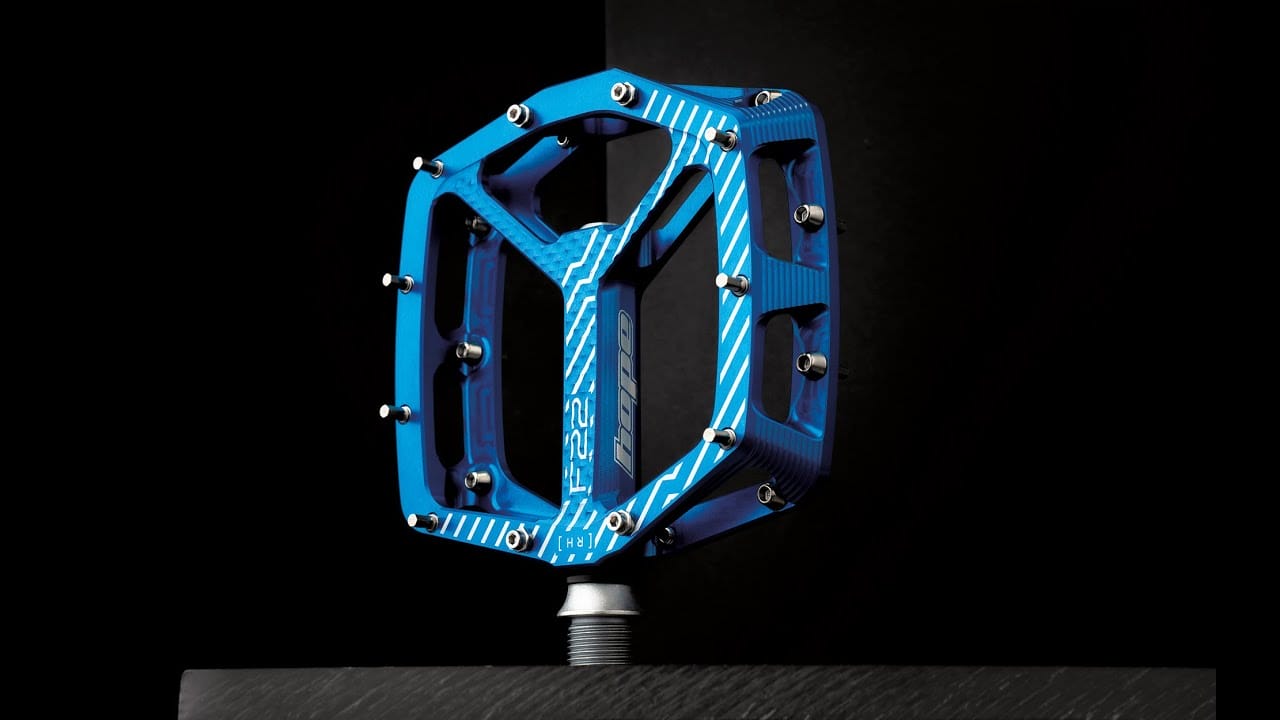
The Hope F22 pedals are Hope’s current flat-pedal answer for riders who want a machined alloy platform with real grip, serviceable internals, and more shoe support than the older F20. They are not cheap composite pedals, and they are not clipless pedals. They are for riders who want a premium flat pedal that can be rebuilt instead of thrown away when the bearings get rough.
The F22 makes the most sense for trail, enduro, downhill, aggressive hardtail, and e-MTB riders who prefer flat pedals but still care about long-term parts support. The key questions are simple: does the platform suit your shoe, do the pins give enough grip, is the serviceability worth the price, and is the F22 enough of an improvement over the older F20?
Quick Verdict
The Hope F22 is a strong choice if you want a premium alloy flat pedal with a supportive platform, adjustable reverse-loading pins, sealed internals, and rebuildable construction. Hope’s F22 product page lists a 360g pair weight, three cartridge bearings, an IGUS bush, internal and external sealing, a revised axle, and a fully serviceable layout.
It is not the best choice if you want the cheapest pedal, the largest possible platform, a very thin body, or a clipless setup. If you are still choosing between Hope flat and clipless models, start with the broader Hope pedals buyer guide first.
Key Specs
| Product | Hope F22 flat pedals |
|---|---|
| Pedal type | Flat/platform mountain bike pedal |
| Body | CNC machined alloy platform |
| Platform shape | Larger concave dome profile with asymmetric and tapered shape |
| Pins | Longer adjustable reverse-loading pins with shorter pins toward the center of the platform |
| Internals | Three cartridge bearings and an IGUS bush |
| Sealing | Internal and external sealing |
| Serviceability | Fully serviceable and rebuildable |
| Claimed weight | 360g per pair |
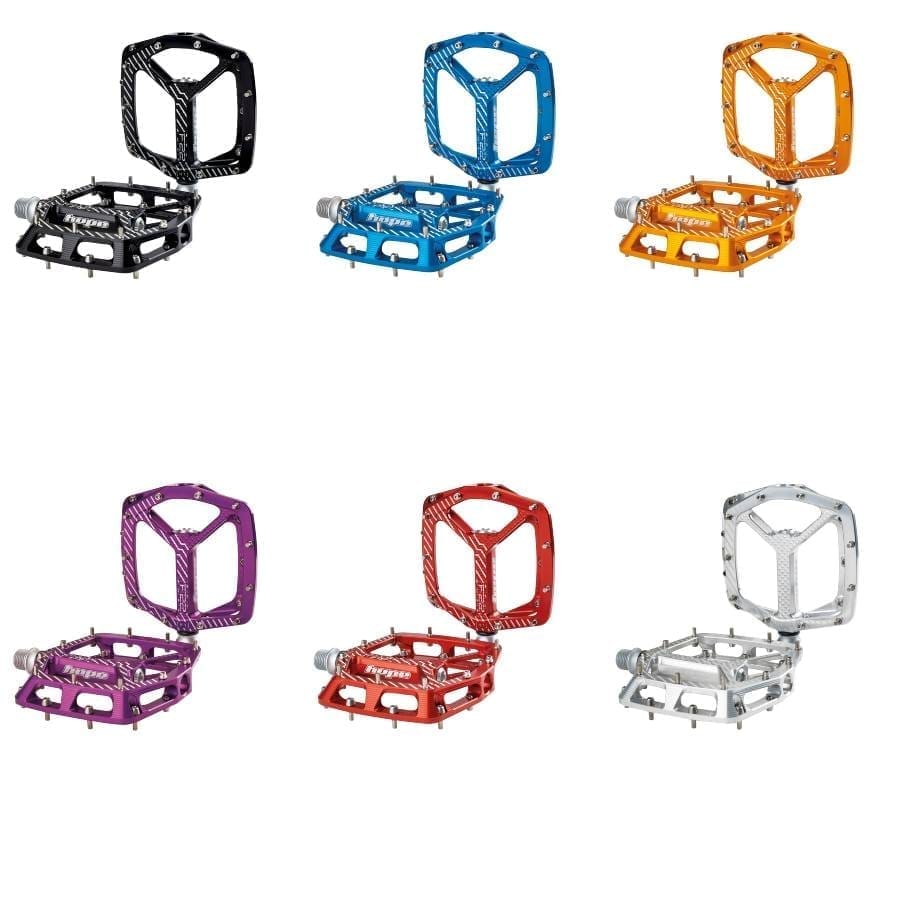
| Colors | Black, silver, smoke, blue, red, purple, and orange |
| Best use | Trail, enduro, downhill, aggressive hardtail, and e-MTB flat-pedal riding |
What Changed From The F20
The F22 exists because the older F20 was serviceable and well made, but its platform shape felt dated next to newer flat pedals. Hope kept the proven internal layout from the F20, then changed the body shape, pin layout, axle design, and foot support.
The useful change is platform feel. Hope describes the F22 as having a larger concave dome profile, an asymmetric/tapered shape, longer adjustable pins, and shorter pins toward the center. That combination is aimed at giving the shoe more support while keeping clearance on tight trails and ruts.
If you already own F20 pedals and like them, the F22 is not a mandatory replacement. If you are buying new, the F22 is the cleaner current choice because it answers the main F20 weakness: modern flat-pedal support and grip.
Grip: Pins Matter, But Shoes Matter Too
The F22 has a more serious pin layout than the older F20. Reverse-loading pins are useful because damaged outer faces are less likely to stop you removing the pin later. Adjustable pin height also gives some room to tune how locked-in the pedal feels.
Still, grip is not only about the pedal. Shoe rubber, tread pattern, pin condition, sole stiffness, and riding style all matter. A sticky flat-pedal shoe can make the F22 feel much more secure. A hard casual shoe can make almost any pedal feel vague.
That is why rider feedback varies. In a Reddit discussion comparing Hope F22, Race Face Atlas, Burgtec, and Wolf Tooth pedals, riders focus heavily on grip, platform size, and pin feel. Treat that as anecdotal, but it reflects the real-world issue: flat pedal preference is personal.
Platform Feel And Foot Support
The F22 is not just a pretty anodized pedal. The platform shape is the reason it exists. The larger concave profile and tapered body are designed to support the shoe while keeping clearance where the pedal can catch trail edges.
This matters most when riding rough ground, landing heavy, or riding long descents where your foot position can drift. A pedal can be grippy but uncomfortable if the shoe support is wrong. The F22 tries to balance grip, support, and clearance rather than only chasing the thinnest possible body.
Bearings, Seals, And Serviceability
Serviceability is one of the strongest reasons to buy Hope pedals. The F22 uses three cartridge bearings and an IGUS bush, with internal and external sealing. Hope also describes the pedal as fully serviceable and rebuildable.
That does not mean the pedal is maintenance-free. Flat pedals live close to grit, water, and impacts. If you ride wet trails or pressure-wash bikes, bearings and seals still need attention. The advantage is that the F22 has a clear service path rather than being a disposable pedal.
Weight And Price Context
Hope lists the F22 at 360g per pair. That is competitive for a serviceable alloy flat pedal, but weight is not the main reason to buy it. The stronger argument is the combination of grip, support, rebuildability, and parts support.
Price is the harder question. Cheaper composite pedals can be excellent, and some riders will get all the grip they need for less money. The F22 is easier to justify if you keep pedals for years, ride rough conditions, and care about service parts. If you replace pedals casually or do not service them, the value case is weaker.
What Rider Feedback Suggests
Public F22 feedback generally points in the same direction: the F22 is a clear improvement over the F20 and a serious premium flat pedal, but pedal preference still depends on shoe, foot shape, and riding style. SingletrackWorld’s early F22 riding impressions were positive about the pedal’s grip and feel, while broader rider threads show that people still compare it closely with Atlas, Burgtec, Wolf Tooth, and other high-grip flats.
That is the right way to frame it. The F22 is not automatically better than every premium flat pedal for every rider. It is a strong option if you like the Hope service model and the platform suits your shoe.
Who Should Buy The F22?
Buy the F22 if you want a premium flat pedal with a machined body, rebuildable internals, adjustable pins, and enough support for serious trail or gravity riding. It is especially sensible if you like keeping parts serviceable instead of replacing pedals when bearings or pins get tired.
It also makes sense if you liked the idea of the F20 but wanted more grip and support. The F22 is the more modern Hope flat pedal, and it is the one most new buyers should consider first.
Who Should Skip It?
Skip it if you want a low-cost flat pedal, a massive platform, a very thin pedal body, or a clipless system. The F22 is also the wrong answer if your shoes do not work well with pins. Flat-pedal grip is a shoe-and-pedal system, not just a pedal purchase.
If you want to stay clipped in, look at Hope Union pedals instead. If you want a broader overview of the Hope pedal family, the Hope pedals guide separates F22, F20, and Union options.
Pros And Cons
| Pros | Supportive current platform, adjustable reverse-loading pins, rebuildable internals, sealed bearing layout, strong color choice, clear improvement over F20. |
|---|---|
| Cons | Expensive compared with composite pedals, not clipless, platform preference is personal, grip depends heavily on shoes, not the thinnest or largest pedal option. |
Bottom Line
The Hope F22 is the Hope flat pedal to buy if you want a premium, serviceable, grippy platform pedal and the shape works with your shoes. It is a meaningful step forward from the F20, mainly because the platform and pin layout feel more current for modern trail and gravity riding.
It is not a universal pedal recommendation. Cheaper composite flats can make more sense for many riders, and clipless riders should look at Union instead. But if you want a rebuildable Hope flat pedal with proper support and a clean service path, the F22 is the strongest option in the range.
FAQ
Are Hope F22 pedals worth it?
They can be worth it if you value a serviceable alloy pedal, strong shoe support, adjustable pins, and long-term rebuildability. If price matters more than serviceability, cheaper composite pedals may be better value.
Are Hope F22 pedals better than F20?
For most new buyers, yes. The F22 has a more modern platform shape and pin layout while keeping Hope’s serviceable internal approach. F20 pedals still matter for owners and used buyers, but F22 is the current choice.
How much do Hope F22 pedals weigh?
Hope lists the F22 at 360g per pair.
Are Hope F22 pedals clipless?
No. The F22 is a flat pedal. If you want clipless Hope pedals, look at the Union range.
Can you service Hope F22 pedals?
Yes. Hope describes the F22 as fully serviceable and rebuildable, with three cartridge bearings and an IGUS bush.
Do Hope F22 pedals have replaceable pins?
Yes. The F22 uses adjustable reverse-loading pins. That design helps reduce the chance of a damaged pin face stopping removal after rock strikes.