Hope Pro 5 148mm Boost Rear Hub Review: 108 POE, Fitment, and Freehub Choice
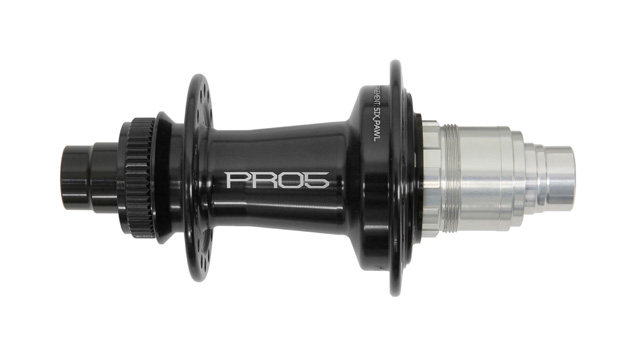
The meaningful change from a Hope Pro 4 rear hub is not the logo or the new shell profile. It is the way the drive mechanism answers two old complaints at once: Pro 5 raises engagement from 44 to 108 points, yet Hope also redesigned the seal, pawls and springs to reduce drag. That makes this 148 mm Boost version most relevant to riders rebuilding a modern mountain-bike wheel who want quicker pickup without moving to an exotic, difficult-to-source hub system.
It is not automatically the right rear hub for every Boost bike. The cassette, rotor, spoke count and intended use determine the exact configuration, and choosing one of those incorrectly can turn a £230 hub into the wrong centrepiece for an expensive wheel build.
Start with the wheel build, not the colour
Hope sells this shell in 24, 28, 32 and 36-hole drillings, with either a six-bolt or Centre Lock rotor interface. The axle standard is 148 × 12 mm Boost. Those choices are structural: the drilling must match the rim and spoke calculation, while the rotor interface must match the rotor you intend to use. End spacers are replaceable, but that does not make a 148 mm shell interchangeable with every rear-hub width.
| Decision | Choose | Hard stop |
|---|---|---|
| Frame | 148 × 12 mm Boost | Do not order for 142, 157 Super Boost or an unidentified dropout standard. |
| Rotor | Six-bolt or Centre Lock | Do not assume an existing rotor transfers between interfaces. |
| Rim | 24, 28, 32 or 36 holes | Hub and rim drilling must match before spokes are calculated. |
| Cassette | HG, Micro Spline, XD or XDR as applicable | Identify the cassette mounting standard, not merely the number of speeds. |
The current Hope product page lists the Centre Lock hub at 313 g and the six-bolt version at 318 g. It also lists an RRP of £230 excluding tax. Treat those as bare-hub figures: the useful purchase comparison is the completed wheel cost, including the correct freehub, rim, spokes, nipples, build labour and any rotor or cassette change forced by an interface mismatch.
What 108 points of engagement changes
The standard driver uses six pawls arranged as two offset groups of three against a 54-tooth ratchet. Three pawls carry the load at a time; the second group is offset between the first group’s engagement positions. That produces 108 pickup positions, or roughly 3.3 degrees of crank rotation at the hub before engagement. The Pro 4’s 44 points equate to about 8.2 degrees.
That shorter pickup gap is easiest to notice when ratcheting pedals through rocks, restarting on a steep technical climb or making partial crank movements where a large dead zone interrupts balance. It is much less important while pedalling continuously on open trail. Faster engagement does not create extra power, and it should not be treated as a universal speed upgrade.
Hope’s Pro 5 launch explanation says the new mechanism was designed around the balance between pickup speed, load capacity, drag and durability. That is the useful generational delta: more pickup positions, revised pawls and springs, a step-down axle that permits larger freehub bearings, and a labyrinth seal that does not rub on the rotating surface.
Lower seal drag is not a promise of a faster bike
“Zero drag” refers to the new labyrinth seal, not to the complete rear wheel. Pawl springs, bearing seals, lubricant, spoke tension, tyre pressure, brake alignment and cassette load still influence what a wheel does. A long workshop spin is therefore useful for detecting brake rub or a binding bearing, but it is not a controlled measure of trail speed.
The sensible reading is narrower: Hope removed the contact drag created by the former drive-side seal and revised the pawl system so the jump from 44 to 108 engagement points did not simply add more spring resistance. Riders choosing between Pro 4 and Pro 5 get a more responsive mechanism without Hope claiming that the hub alone will make every bike measurably faster.
Choose the driver before the cassette arrives
“All modern freehub bodies” is not permission to choose one casually. Shimano HG is used by many traditional splined cassettes; Shimano Micro Spline is the common choice for Shimano 12-speed mountain-bike cassettes with a 10-tooth smallest sprocket; SRAM XD serves most modern SRAM mountain cassettes; XDR is longer and primarily associated with road and gravel cassettes. Confirm the exact cassette model against its manufacturer’s compatibility table.
The official Pro 5 hub-document library provides separate exploded drawings for HG, Micro Spline and XD/XDR 108-point drivers. That separation matters during service: spacers, seals and the outer bearing arrangement are not identical across every body. The Micro Spline drawing, for example, identifies a 17 × 28 × 7 inner bearing and a 15 × 24 × 10 double-row outer bearing, along with six HUB559 pawls and six HUB560 pawl springs.
Do not substitute the e-bike driver
The standard 108-point mechanism alternates two sets of three pawls. Hope’s e-bike-specific version uses a different load strategy, with all six pawls engaging together and 54 points of engagement. That sacrifices some pickup resolution to share motor-assisted load across all six pawls.
This distinction repeatedly causes confusion in owner discussions. In a Singletrack World Pro 5 thread, riders initially disagreed over why a freehub could be marked 54 POE while the standard hub is advertised at 108; later replies correctly separated the simultaneous e-bike arrangement from the offset standard driver. Use the exact freehub part for the intended hub and application rather than treating the two mechanisms as interchangeable upgrades.
The mechanic’s tray: what Hope actually specifies
The current official 148 mm six-bolt exploded drawing identifies two 17 × 30 × 7 shell bearings, the HUB1018-57 148 mm rear axle, HUB1018-48 non-drive-side spacer and separate HG, Micro Spline and XD/XDR freehub assemblies. Hope’s service-tool chart then assigns dedicated press tools rather than a generic socket:
| Service position | Official tool ID | Tool description |
|---|---|---|
| Six-bolt rear, drive side | HTT196 | Pro 5 rear bearing press tool, short |
| Six-bolt rear, non-drive side | HTT195 | Pro 5 rear bearing press tool, long |
| HG freehub, drive side | HTT197 | Pro 5 freehub bearing press tool, long |
| HG freehub, non-drive side | HTT199 | Pro 5 freehub bearing press tool, short, 11-speed |
| XD or Micro Spline freehub, drive side | HTT197 | Pro 5 freehub bearing press tool, long |
| XD or Micro Spline freehub, non-drive side | HTT198 | Pro 5 freehub bearing press tool, short, MS/XD |
Hope notes that these tools are included in its Pro 5 Tool Kit HTTPro5. The current exploded drawing and service-tool chart do not publish a universal hub-bearing torque value. That is not a reason to borrow a number from a rotor, axle or older Pro 4 document: press-fit bearings are installed by controlled pressing against the correct race, while cassette, rotor and frame-axle torque must come from the instructions for those exact components.
Noise and failure reports need proportion
Owners do not describe the Pro 5 as silent, but several riders in the same long-running hub discussion call its tone quieter or less sharp than the Pro 4. Others still consider it conspicuous. Sound depends on grease quantity, freehub speed and the acoustic effect of the wheel and frame, so a forum description is useful for setting expectations rather than proving mechanical condition.
There are also isolated reports of a displaced freehub retaining clip and damaged ratchet teeth. One owner reported repeated retaining-clip movement, while another owner in the discussion reported thousands of miles without the issue. A separate repair thread shows damaged engagement teeth and slipping pawls. These posts demonstrate possible failure modes, not their frequency. If the cassette develops axial movement, the driver disengages under load or metal damage is visible, stop riding and have the hub inspected rather than treating internet anecdotes as a home repair specification.
Buy, rebuild or skip?
- Buy it when the bike is definitely 148 × 12 mm Boost, the wheel is being built around a matching drilling and rotor interface, and quick pickup plus rebuildable parts justify the completed-wheel cost.
- Rebuild an existing Pro 4 wheel instead when 44-point pickup is already adequate and its shell, bearings and freehub remain serviceable. A hub change normally means new spokes and a fresh wheel build, so MSRP alone hides much of the upgrade cost.
- Choose the e-bike-specific Pro 5 when the application calls for Hope’s six-pawls-together, 54-point motor-load design.
- Skip this configuration if frame spacing, cassette body, rotor interface or rim drilling is still unknown. Resolve those four fields before selecting colour or ordering spokes.
For the correct 148 mm Boost build, the Pro 5’s case is stronger than a simple “more engagement” pitch. It combines materially quicker pickup with a lower-drag seal architecture, replaceable drivers and documented service tooling. Its value is weakest when the wheel build has not been specified first—or when a sound preference is being mistaken for a performance requirement.