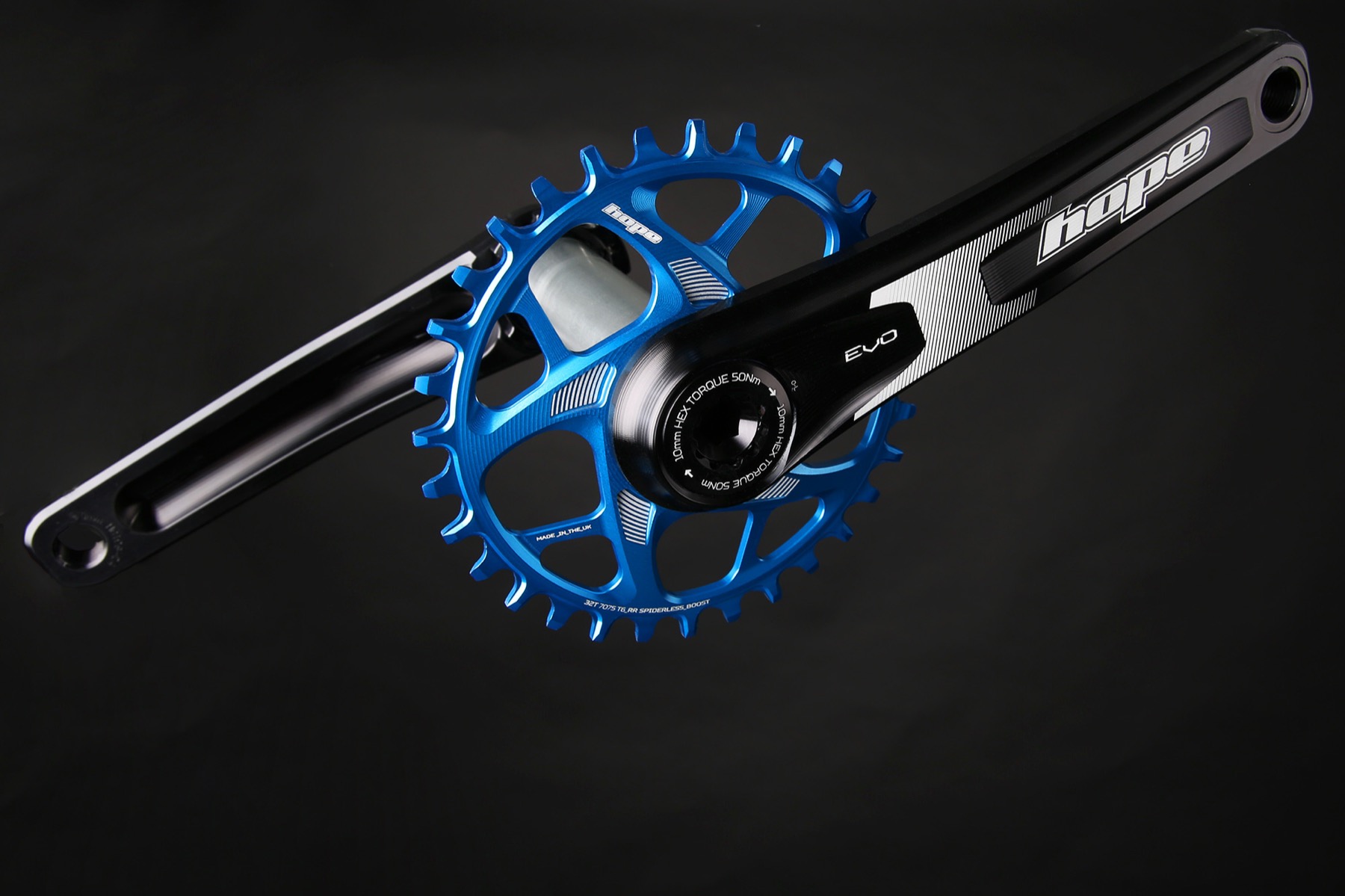
Hope R22 Spiderless Chainring Review: Offset, Chainline, and Drivetrain Fit
The Hope R22 Spiderless Chainring is one of those parts that looks simple until you start checking the details. It is a direct-mount narrow-wide chainring for Hope cranksets, available in standard and boost offsets, with Hope’s newer R22 tooth profile for modern 1x drivetrains. If the crank, offset, tooth count, and chainline all match, it is a clean lightweight upgrade. If one of those details is wrong, it can become an expensive fitment lesson.
That is the useful way to review it. The R22 is not just a colored chainring. It is a compatibility part. It has to match your crank, drivetrain, chainline, tooth count, and clearance needs before the color or weight saving matters.

Quick verdict
The Hope R22 Spiderless Chainring makes sense if you run a compatible Hope EVO crankset and want a direct-mount 1x ring with modern drivetrain compatibility, strong chain retention, and standard or boost offset options. It is especially useful if you want to tune tooth count and chainline without using a separate spider.
Skip it if you are not sure which Hope crank interface you have, if you need a BCD chainring instead, if your frame/crank clearance is tight with smaller tooth counts, or if you are buying an e-bike version without confirming the motor-specific mount. This is not a part to choose only by color.
What the R22 Spiderless Chainring is
Hope’s Spiderless Chainring product page describes the R22 as a direct-mount retainer ring for Hope cranksets, with standard and boost options. Hope says it is compatible with 9, 10, 11, and 12-speed drivetrains, including SRAM T-Type and Shimano HG+.
The R22 tooth profile is the main update. Hope says the asymmetric tooth profile is designed for cross-compatibility across drivetrain systems, improved mud shedding, improved chain retention, better performance at extreme chain angles, and more wear before function is compromised.
Key specs and fitment details
| Part type | Direct-mount spiderless narrow-wide chainring / retainer ring |
|---|---|
| Crank fit | Designed specifically for compatible Hope cranksets |
| Drivetrain compatibility | Hope lists 9/10/11/12-speed compatibility, including SRAM T-Type and Shimano HG+ |
| Offsets | Standard or Boost offset options |
| Tooth range | 28T to 36T on Hope’s product page |
| Material | CNC-machined 7075-T6 aluminium |
| Claimed weights | Hope lists 30T 61 g, 32T 64 g, 34T 72 g, and 36T 80 g |
| Main caution | Confirm crank interface, offset, chainline, tooth count, and clearance before ordering |
Who should choose it?
Choose the R22 Spiderless Chainring if you already know you have the right Hope crankset and want a neat direct-mount 1x setup. It is a clean option for riders who want to remove the separate spider, save a bit of weight, run smaller ring sizes, and keep a Hope-finished drivetrain.
It also makes sense if you are changing drivetrain type and need a tooth profile that plays more nicely with modern chains. Hope specifically calls out SRAM T-Type and Shimano HG+ compatibility, which is the kind of detail that matters now because chain profiles and shifting behavior have become more specific than they used to be.
Who should skip it?
Skip it if you are not running a compatible Hope crank. A spiderless ring is not the same as a 104 BCD ring, 110 BCD ring, SRAM 3-bolt ring, or e-bike direct-mount ring. Hope’s chainrings category page lists several different chainring families, and they are not interchangeable just because they are all Hope chainrings.
Also skip it if you cannot confirm clearance for the tooth count you want. Smaller rings can create chain/crank or chainstay clearance surprises on some setups. If you are changing from a larger ring to a smaller one, check the actual bike before assuming the ring will clear everything.
Standard vs Boost offset
The offset choice is not cosmetic. Standard and Boost rings exist to put the chainring in the right place for the rear hub spacing and crank setup. The goal is a sensible chainline so the chain does not run at a bad angle across the cassette.
If you choose the wrong offset, the bike may still pedal, but the chainline can be poor. That can mean more noise, more wear, worse chain retention, and rougher shifting at the cassette extremes. Before buying, check the crank model, rear hub spacing, chainline target, and Hope’s chainring instructions rather than guessing from the old ring’s color or tooth count.
Tooth count and clearance
Hope lists a 28T to 36T size range for the spiderless chainring. Smaller rings can be useful for steep climbing, loaded riding, or riders who want easier gearing. Larger rings can suit faster terrain or stronger riders who want more top-end speed.
The catch is clearance. A BikeWrench discussion about a Hope R22 32T fit issue is a useful reminder: one rider had the chain touching the crank arm after fitting a smaller ring, and replies pointed toward crank/ring clearance rather than a simple chainring defect. Treat that as one rider’s setup issue, not a blanket warning, but it shows why tooth count and clearance should be checked before ordering.

R22 vs older Hope spiderless rings
The reason to care about R22 is the updated tooth profile and drivetrain compatibility. Hope’s R22 launch notes describe the chainring as designed for modern drivetrain systems, with compatibility across 9, 10, 11, and 12-speed drivetrains including SRAM T-Type and Shimano HG+.
If your old ring still works with your current drivetrain, you do not need to replace it just for the label. But if you are moving to a newer chain/cassette setup, or if your old chainring is worn, R22 is the current Hope direction to check first.
E-bike versions need extra care
The e-bike versions are a separate compatibility problem. Hope lists e-bike chainrings separately from the standard spiderless chainring family, and the product documents include different e-bike spiderless chainring instructions for Bosch, Brose, and Shimano systems. Do not assume a normal Hope crank spiderless ring fits an e-bike motor interface.
If you are shopping for Bosch Gen 4, Brose/Specialized, or Shimano EP8/E8000 style systems, check the exact e-bike chainring document and chainline requirement. The product name may sound similar, but the mount is not something to improvise.
Install notes
Install is straightforward only if the part is correct. Remove the old ring or spider, clean the interface, check the lockring or fixing hardware, and follow Hope’s torque and thread-prep guidance in the instructions. Do not use threadlocker, grease, or torque values by habit if the manual says otherwise.
After installation, check the chain on the stand before riding. Look at chainline in the easiest and hardest gears, listen for rubbing, and check that the chain seats properly on the narrow-wide teeth. Then ride gently before calling it solved.
Pros and cons
- Pros: direct-mount simplicity, standard and boost offset options, 9/10/11/12-speed compatibility claim, SRAM T-Type and Shimano HG+ support, improved mud shedding, improved chain retention, 7075-T6 aluminium construction, and strong Hope color options.
- Cons: only right for compatible interfaces, offset mistakes can hurt chainline, smaller tooth counts can create clearance surprises, e-bike versions require separate checks, and it is not a universal chainring.
Bottom line
The Hope R22 Spiderless Chainring is a strong option when the fitment is correct. It gives Hope crank users a neat direct-mount 1x ring with modern drivetrain compatibility and a tooth profile designed for current chain systems.
The main advice is to buy it like a fitment part, not like an accessory. Confirm crank interface, standard or boost offset, tooth count, chainline, and clearance first. Once those are right, the R22 makes a lot of sense.
FAQ
Does the Hope R22 Spiderless Chainring fit any crank?
No. It is a direct-mount ring designed for compatible Hope cranksets. It is not the same as a 104 BCD, 110 BCD, SRAM 3-bolt, RX, or e-bike motor-specific chainring.
Is it compatible with SRAM T-Type?
Hope lists the R22 spiderless chainring as compatible with 9, 10, 11, and 12-speed drivetrains, including SRAM T-Type and Shimano HG+.
Should I choose standard or boost offset?
Choose the offset that matches your crank, rear hub spacing, and chainline requirement. Do not choose offset by color, availability, or guesswork.
Can I fit a smaller ring for easier climbing?
Possibly, but check clearance. Smaller rings can make gearing easier, but on some crank/frame setups the chain may sit closer to the crank arms or frame.
Is the R22 the right ring for e-bikes?
Only if you choose the correct e-bike-specific version for the motor interface and chainline. Bosch, Brose/Specialized, and Shimano systems need separate compatibility checks.