Hope RX2 Review: DOT Fitment Checks Before You Buy
The Hope RX2 makes the most sense when the problem is not simply "more brake." It is for a road, gravel or CX bike where a smaller Hope flat-mount caliper may fit more cleanly than the larger RX4+, especially around tight rear-frame clearance. The catch is that the RX2 is not a casual bolt-on choice. Fluid type, lever family, hose fittings, bracket choice, rotor size and bleed setup all have to line up before the caliper is worth buying.
HometownBikes has not personally tested this caliper. This article is based on Hope technical documents, independent reporting and clearly limited owner/community reports. Performance feel is therefore handled cautiously, while fluid, bleed and mount checks are treated as the parts of the decision that can be verified more directly.
Check The Brake System First
RX2 is sold around a tempting idea: a compact Hope road/gravel caliper with a smaller footprint than RX4+. That is useful only if it belongs in the brake system already on the bike.
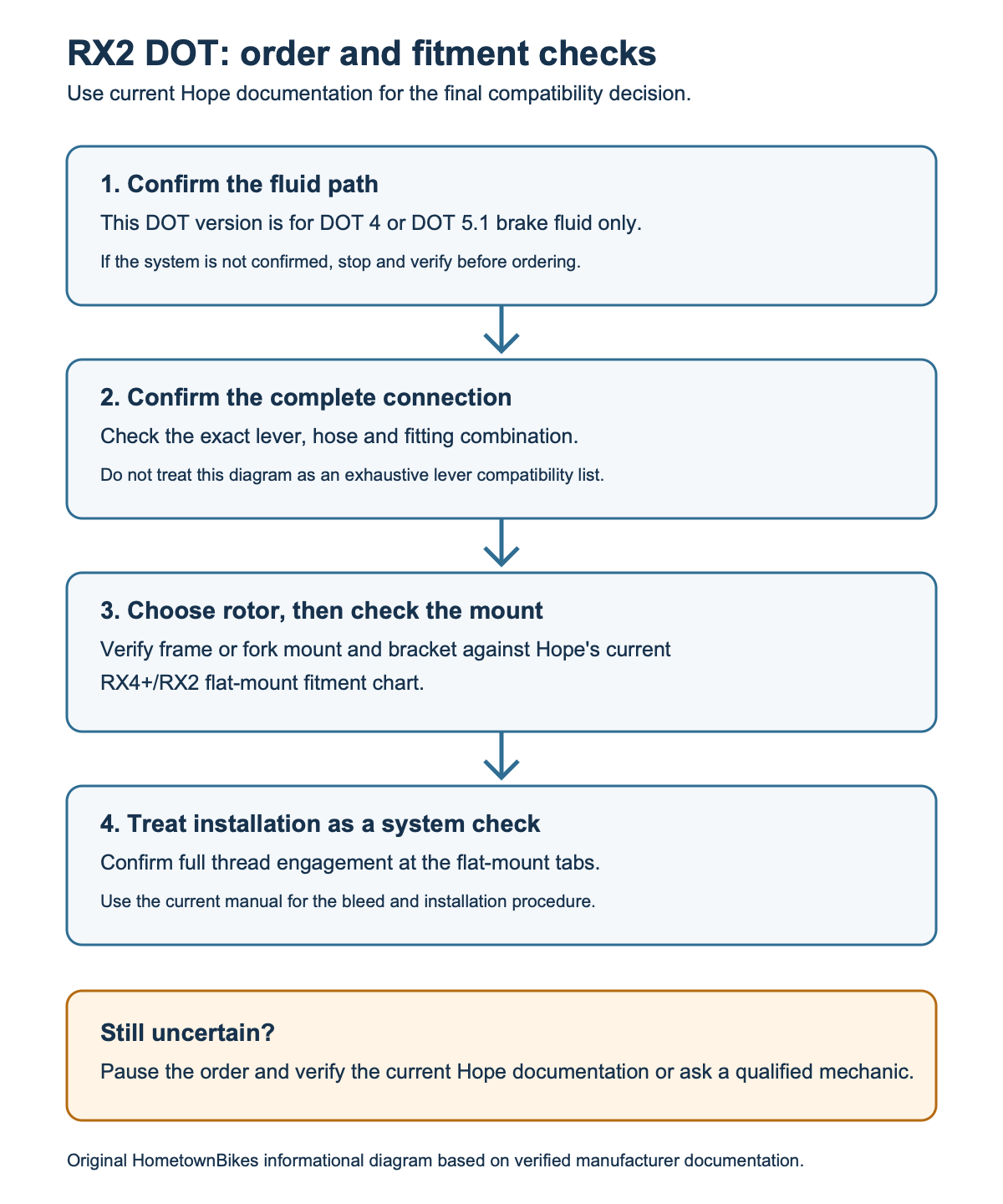
The most important split is fluid. Hope's RX DOT instruction document states that the RX DOT caliper works with DOT 4 or DOT 5.1 brake fluid only. That makes the DOT version a candidate for compatible DOT-fluid road or gravel systems, but it does not make it a universal SRAM upgrade. Exact lever generation and hose hardware still need confirmation before ordering.
It also means Shimano GRX should not be treated as automatically compatible with this DOT article. If a reader is comparing against a mineral-oil GRX setup, they need the correct mineral-oil RX2 version and a separate compatibility check, not the DOT caliper covered here.
The Fitment Checks That Decide The Purchase
The RX2 decision is mostly a fitment decision. If any of these checks fail, the caliper is the wrong purchase regardless of how attractive the machining, colors or weight claim may be.
| Check | What can be used from the evidence | What still needs confirmation |
|---|---|---|
| Fluid | Hope RX DOT documentation supports DOT 4 or DOT 5.1 only. | Do not mix this up with the mineral-oil RX2 version. |
| Lever | DOT-fluid road/gravel lever compatibility is the target use case. | Confirm the exact lever family and generation with Hope or the lever maker. |
| Hose and fittings | Hope's manual discusses the RX DOT caliper-end bleed adapter and original fittings at the lever end. | Check the hose insert, olive and lever-end hardware for the actual build. |
| Mount | Hope's fitment material points RX2 users to the RX4+/RX2 flat-mount chart. | Use the chart for the exact frame/fork mount, front or rear position and disc size. |
| Rotor | Rotor size affects whether direct mount, Y mount or Z mount applies. | Do not assume a bracket because another bike used it. |
| Clearance | The RX2 is positioned as the smaller option compared with RX4+. | Rear triangle and chainstay clearance still need checking on the actual frame. |
DOT, SRAM And Shimano GRX: Avoid The Fluid Mix-Up
Search results around RX2 mix several different questions: SRAM road levers, Shimano GRX, RX2, RX4+, X2 and sometimes mineral-oil calipers. That creates a real buying risk because the same name can pull readers toward the wrong fluid system.
For this DOT-focused RX2 article, the safe statement is narrow: the accessible Hope RX DOT manual verifies DOT 4/DOT 5.1 use and the RX DOT bleed process. It does not, by itself, prove every SRAM Red, Force, Rival, Apex or eTap AXS generation. A retailer or forum post may list lever families, but the final check should be the current Hope compatibility information and the lever maker's service guidance.
That may sound conservative, but brakes are the wrong place to guess. If the bike is running mineral oil, the DOT caliper is not the answer. If the bike is running SRAM DOT, the next question is still whether the exact lever, hose and fitting combination is supported.
Use Hope's Flat-Mount Chart Before Choosing A Rotor
Hope's RX DOT manual tells readers to refer to the RX4+/RX2 flat-mount fitment chart, and the extracted chart includes RX2 flat-mount combinations using direct mount plus X, Y and Z mount options depending on front/rear position and disc size.
The practical takeaway is simple: choose the rotor first, then verify the frame or fork mount and bracket against Hope's current chart. A 140 mm rear setup, 160 mm front setup and larger rotor plan can all imply different hardware. The manual also warns that full thread engagement is required when installing the caliper on fork or rear flat-mount tabs.
This is where a lot of online RX2 discussion becomes less useful. Someone else's mount choice only proves what worked on that frame, fork and rotor. It does not prove the bracket for a different bike.
RX2 Versus RX4+: Smaller Caliper, Different Risk
RX4+ is the bigger, four-piston Hope road/gravel caliper. RX2 is the smaller two-piston option. Bikerumor's Sea Otter roundup describes Hope's positioning: RX4 offered big drop-bar braking power, but it did not fit every frame and not every rider needed that much caliper; RX2 was introduced as the lighter, smaller two-piston answer. Bikerumor also reports Hope's claim that RX2 power is similar to RX4+, but that remains a manufacturer claim unless independently tested on the same setup.
So the RX2-versus-RX4+ choice should not be framed as one always being better. A cleaner way to decide is this:
| If your priority is… | RX2 looks more relevant when… | RX4+ deserves a look when… |
|---|---|---|
| Rear-frame clearance | The rear flat-mount area is tight and a compact caliper matters. | The frame clearly has room for the larger caliper. |
| Simpler pad clearance | You want the smaller two-piston package and less caliper bulk. | You are willing to manage the bigger four-piston setup. |
| Maximum braking margin | You mainly need correct fitment and a road/gravel upgrade path. | You specifically want Hope's larger four-piston caliper and can verify clearance. |
| Evidence certainty | You can verify the exact DOT RX2 setup. | You have independent RX4+ evidence for your lever/frame use case. |
The RX2 may be the more sensible caliper on many gravel bikes simply because it solves a fitment problem. That is different from claiming it matches RX4+ performance in every situation.
Bleeding The RX2 Is Part Of The Install
Hope's RX DOT manual is detailed enough to make one thing clear: this is a proper hydraulic brake installation, not just a caliper swap. The manual calls for DOT fluid, a caliper-specific bleed block, the RX DOT caliper-end bleed adapter or SRAM bleeding edge, and the appropriate master-cylinder bleed kit at the lever end.
The manual also highlights details that affect the final result. It tells the installer to position the caliper at the lowest point of the system, notes that internal hose routing around the bottom bracket can trap air, and explains that both pads should contact the disc evenly for optimized lever feel. It also warns about proper thread engagement at the mount.
That does not mean the RX2 is unusually difficult. It means the buyer should budget for the complete job: caliper, bracket if needed, hose/fitting parts if needed, pads, rotor compatibility, bleed tools, DOT fluid and mechanic time if they are not doing the work themselves.
What Current SRAM E1 Reports Can And Cannot Prove
The owner evidence available here is useful, but not broad enough to turn into sweeping claims. In an Escape Collective discussion about SRAM E1 levers and Hope brakes, one rider reported using E1 levers with RX2 and described strong stopping power, while other comments around RX4+ focused on pad-clearance and piston-maintenance tradeoffs. That is helpful context, but it is still a small community thread, not a controlled RX2 test.
A separate installation-style blog post on a Specialized Creo 2 repeats the same general RX2 positioning: compact caliper, two-piston layout, flat-mount standard and bracket compatibility. That report is useful because it reflects a real installation context, but it should not be treated as proof that every Creo, gravel frame or SRAM setup will fit without checks.
Use these reports for the questions they actually answer: riders are comparing RX2 against RX4+, some care about tight rear clearance, and SRAM lever compatibility is a common concern. Do not use them as a substitute for Hope's current chart and service documents.
Pre-Order Checklist
Before buying the Hope RX2 DOT caliper, confirm these items in order:
- The bike uses a DOT-fluid brake system, not a mineral-oil brake system.
- The exact lever model and generation is compatible with the RX2 DOT caliper.
- The hose, olive, insert and lever-end fitting plan is known.
- The frame or fork is flat mount and the front/rear position is confirmed.
- Rotor diameter is chosen before selecting direct mount, Y mount or Z mount.
- The mount hardware gives correct thread engagement.
- The bleed kit covers both the lever end and the RX DOT caliper end.
- Frame clearance is checked if the reason for choosing RX2 is tight rear space.
For broader brake-family context, the Hope brakes guide is the better follow-up after the RX2 fitment checks are clear.
When The RX2 Makes Sense
The Hope RX2 DOT caliper is worth considering when you want a compact Hope flat-mount caliper for a DOT-fluid road, gravel or CX setup and you are prepared to verify the lever, hose, bracket and rotor details before buying.
The strongest reason to choose it is packaging: RX2 aims at drop-bar bikes where the larger RX4+ may be more caliper than the frame, rider or use case needs. The biggest reason to pause is compatibility. If the lever family, fluid type, mount hardware or rotor combination is uncertain, solve that first or involve Hope, the lever manufacturer or a qualified mechanic.