Hope F20 Pedals Review: Still Worth Servicing or Upgrade to F22?
The Hope F20 pedal still matters, but not in the same way it did when it was Hope’s main flat pedal. Today it is mostly an owner, used-market, service, and comparison topic. If you already have F20s, the question is whether to keep them alive. If you are buying now, the question is whether a clean F20 pair makes more sense than the newer F22.
The short answer: a good F20 is still worth servicing if you like the shape and the body is healthy. For most new buyers, the F22 is the cleaner Hope flat-pedal choice because it updates the platform support, pin layout, and axle design while keeping the rebuildable Hope idea.
Quick Verdict
Keep or service Hope F20 pedals if they spin smoothly after maintenance, the axle is straight, the body is not badly damaged, the pins still suit your shoes, and you like the platform feel. The F20’s strongest argument is long-term ownership: a machined body, replaceable pins, cartridge bearings, a bush, and service parts.
Upgrade to F22 if you want a more modern Hope flat pedal with stronger shoe support and a more current pin/platform design. Hope’s F22 product page says the newer pedal keeps the proven F20 internal layout but adds a larger concave dome profile, reverse-loading pins, internal and external sealing, and a revised axle.
Hope F20 Key Specs
| Part type | Flat/platform mountain-bike pedal |
|---|---|
| Body | Fully CNC-machined aluminium platform, according to Hope’s F20 instructions |
| Axle | High-strength Cr-Mo axle |
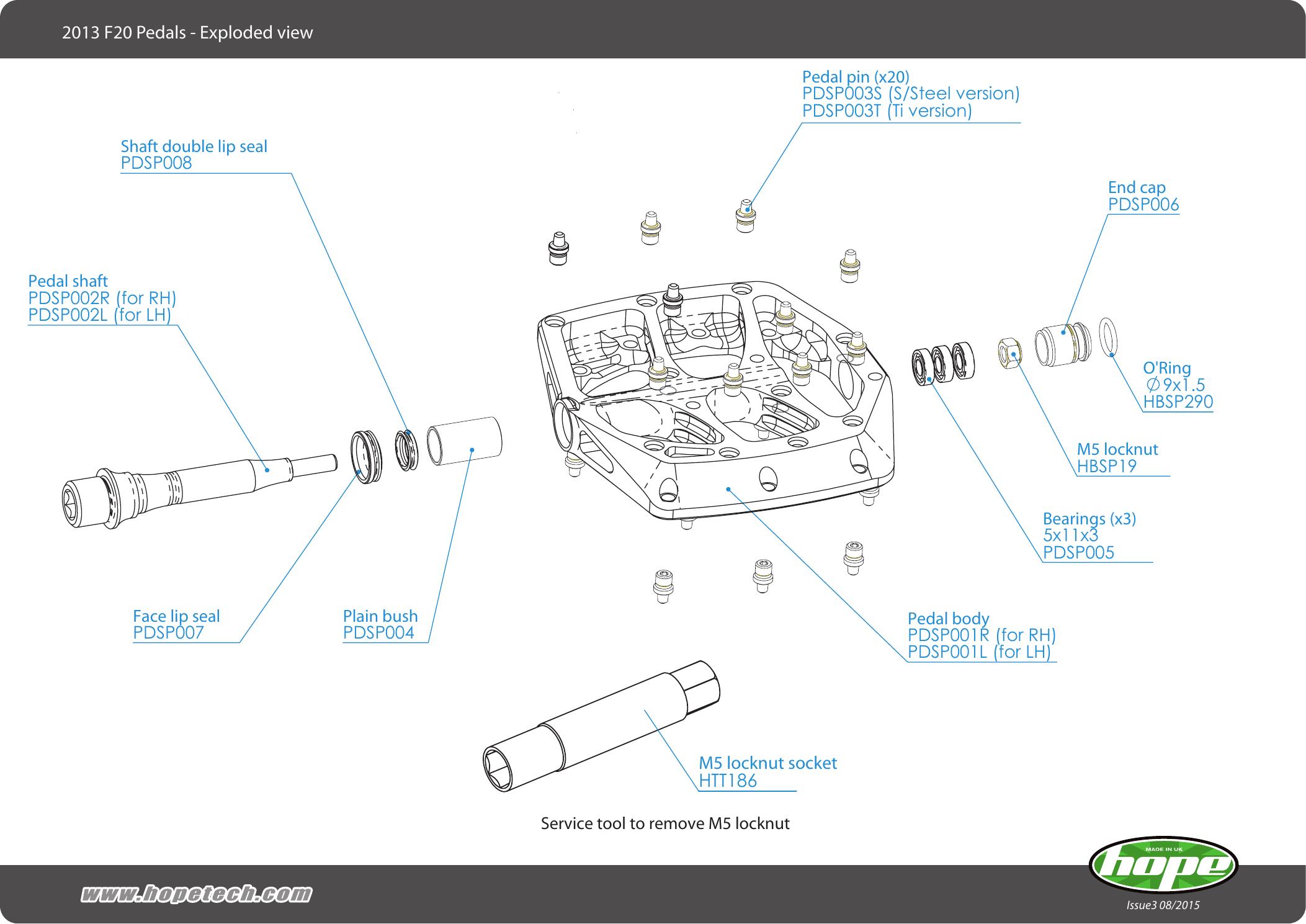
| Pins | 20 pedal pins shown in Hope’s F20 exploded view |
| Internals | Three 5x11x3 bearings plus a plain bush shown in the exploded view |
| Service parts | Face lip seal, shaft double lip seal, O-ring, end cap, M5 locknut, and service socket references |
| Best current role | Existing-owner service, used-pedal checks, and F20-to-F22 comparison |
What the F20 Still Gets Right
The F20 still makes sense if you value rebuildable hardware. Hope’s official F20 exploded view shows a proper parts layout: pedal body, shaft, pins, three bearings, plain bush, seals, O-ring, end cap, locknut, and the HTT186 socket tool. That is the reason owners still talk about servicing F20s instead of throwing them away.
The pedal also still looks like a Hope product: machined shape, anodized finish, and a parts-first approach. If you already own a pair and the bodies are not beaten beyond sense, it can be smarter to refresh them than to buy another pedal just because a newer model exists.
Where the F20 Feels Dated
The F20’s weakness is not that it was badly made. It is that flat-pedal expectations moved on. Riders now expect bigger support, more concavity, better pin tuning, and platform shapes designed around modern flat-pedal shoes.
That is why the F22 exists. Hope describes the F22 as the next evolution of its flat pedal, with better stability, shoe support, and grip. The F20 can still be good under the right shoe, but it is no longer the easiest recommendation for a fresh premium flat-pedal purchase.
Grip and Shoe Feel
The F20 can feel secure with the right shoes, but grip is personal. Shoe rubber, sole stiffness, tread shape, pin condition, foot size, and riding style all matter. A rider who likes a little foot movement may prefer the F20 more than someone chasing the most locked-in modern pedal feel.
That split shows up in rider discussions. In one Reddit discussion about premium pedals, a rider says the previous Hope F20 shape did not suit them underfoot, while the broader thread shows how strongly pedal feel depends on the person and shoe. Treat that as anecdotal, but it is exactly the point: F20 fit is not universal.
Serviceability and Used-Buy Checks
If you are buying used F20 pedals, inspect them like serviceable parts, not like decoration. Check bearing roughness, axle straightness, side play, missing pins, damaged pin holes, gouged bodies, pedal threads, and whether the end cap and locknut hardware are still healthy.
Hope’s F20 instructions are worth having nearby before any service work. The important buyer point is simple: a used F20 with healthy bodies and serviceable internals can be a good long-term pedal. A used F20 with damaged bodies, rounded hardware, and rough internals can become poor value quickly.
F20 vs F22
The F22 is the better choice for most new buyers. It keeps the serviceable Hope layout but gives a more current platform. The F20 is still relevant for owners, used buyers, and riders who already know they like the older shape.
The decision is not emotional. If you already own F20s and like them, service them. If you are buying new and want the strongest current Hope flat pedal, start with F22. If you are comparing both directly, read the full Hope F22 vs F20 pedals guide.
Who Should Keep the F20
Keep the F20 if you like the platform, use shoes that work well with it, and the pedal is mechanically healthy. It also makes sense if you prefer maintaining parts instead of replacing them and already have access to the correct service parts or tools.
In a Reddit thread from an F20 owner considering F22s, the useful signal is long-term ownership: the rider reports many years of F20 use in poor conditions before even thinking about changing. That is one person’s experience, not proof for every pedal, but it matches the F20’s serviceable-pedal appeal.
Who Should Skip the F20
Skip the F20 if you want the most modern flat-pedal shape, the newest Hope pin layout, or a straightforward new purchase. Also skip it if the used pair has bent axles, badly damaged bodies, rough bearing seats, missing hardware, or pin holes that no longer hold pins properly.
If your goal is maximum grip and support from a new Hope flat pedal, the F22 is the better place to start.
Related HometownBikes Reading
For the current flat-pedal review, read the Hope F22 pedals review. For service details, read the Hope pedal pins and service guide. For the full family choice, read Are Hope pedals good?.
Pedal grip, shoe support, and foot stability are easier to judge when the bike is not bouncing around on the wrong tire setup. Before deciding whether an older flat pedal feels harsh or vague, check your baseline with the bike tire pressure calculator.
Bottom Line
The Hope F20 is not the default new-buy recommendation anymore, but it is not useless. A healthy pair is still worth servicing if you like the feel. A rough used pair should be judged by body condition, axle condition, pins, bearings, bushings, seals, and tool access.
For most riders buying fresh Hope flat pedals, choose F22. For riders who already own F20s and like them, keeping them running can still make sense.
FAQ
Are Hope F20 pedals still good?
Yes, if the body, axle, bearings, bush, seals, and pins are in good condition and you like the older platform feel. They are no longer the cleanest new-buy recommendation because the F22 is the current Hope flat pedal.
Should I upgrade from Hope F20 to F22?
Upgrade if you want a more modern platform, more current pin layout, and better shoe support. Do not upgrade just because the F22 exists if your F20 pedals are healthy and you like them.
Are Hope F20 pedals serviceable?
Yes. Hope’s exploded view shows replaceable pins, three bearings, a plain bush, seals, O-ring, end cap, locknut, and a specific service socket.
What should I check before buying used Hope F20 pedals?
Check axle straightness, bearing roughness, side play, pedal threads, body damage, pin condition, missing hardware, and whether service parts are still available for the exact repair you need.
Are Hope F20 pedals better than F22?
Usually no for new buyers. The F22 is the newer, more modern flat pedal. The F20 can still be better for a rider who already owns it, likes the shape, and only needs a service refresh.