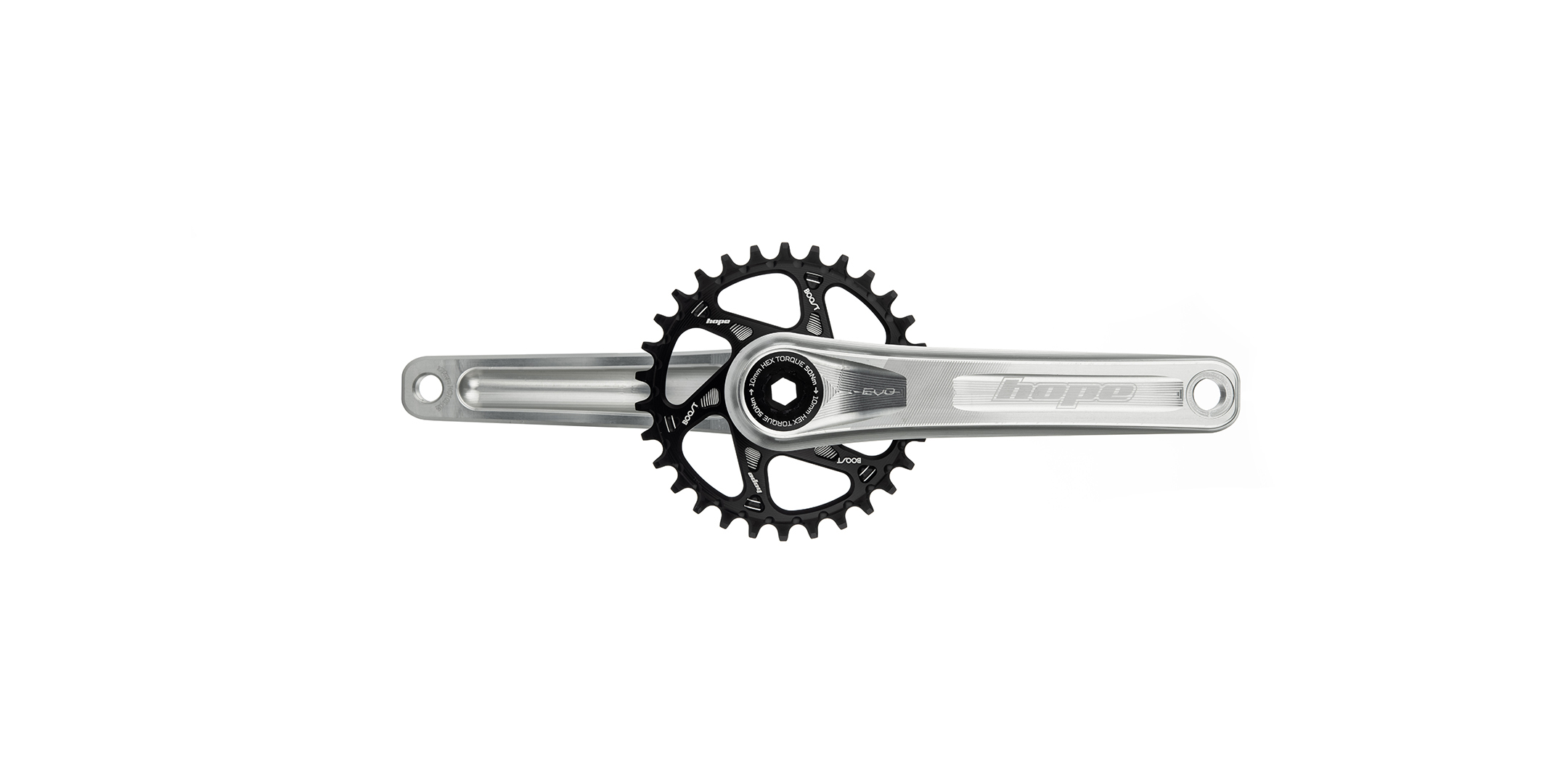
A Hope crankset becomes a sensible upgrade when the bike needs something the current cranks cannot provide: a shorter arm to reduce pedal strikes, a different axle for a difficult frame layout, or a serviceable alloy system that can be configured around a specific chainline. The EVO range offers those choices, but its value depends on selecting the complete configuration rather than buying the arms from a weight figure alone.
This guide uses Hope’s current product documents and installation instructions, then checks the buying trade-offs against attributed independent tests and owner installation reports. HometownBikes has not ride-tested this crankset.
Weight by crank length and complete configuration
Hope's EVO crankset specifications list a starting weight of 560 g for a 170 mm setup including the axle. Hope offers 135, 155, 165, 170 and 175 mm crank lengths, so the number changes with the selected arms and axle configuration.
Your installed weight also includes the chainring or spider, bottom bracket interface and small hardware; Hope's own product information makes clear that the assembled setup depends on the selected configuration. For a purchase comparison, weigh the exact build you are replacing and compare like for like rather than comparing Hope's starting number with a rival's complete-system number.
Mountain bike and e-bike suitability
The EVO is a premium alloy MTB crank platform built around forged and CNC-machined 7150-series aluminium arms and a 30 mm 7075 aluminium axle. Hope describes the available axle options as covering bikes from XC and trail use through DH, fat-bike and SuperBoost applications, subject to the correct configuration. That makes the EVO a sensible candidate for riders who want a configurable alloy system and intend to keep parts in service, but it does not make it automatically correct for every e-bike or frame.
After six months on the cranks, Singletrack World focused on the EVO's construction and unusual choice of lengths rather than weight alone. For an e-bike, confirm the manufacturer's drivetrain and frame requirements, axle length, chainline and clearance before ordering; the word 'EVO' alone is not a compatibility check.
Installing Hope cranks: tools and torque settings
Hope's EVO system uses a self-extracting axle-and-arm interface and a spline mount for the chainring or spider. The Hope EVO installation manual specifies a 10 mm hex key, a 2.5 mm hex key and a torque wrench. The supplied spider lockring tool is Hope HTT192, driven with a standard bottom-bracket spanner, a 38 mm socket, or held upside down in a vice.
Torque the spider or spiderless-chainring lockring to 50–60 N·m and spider-mounted chainring bolts to 10–12 N·m. Torque the drive-side crank bolt to 50 N·m with the 10 mm hex key; set the bearing preload nut by hand only, then tighten its 2.5 mm-hex pinch bolt to 0.6–0.8 N·m.
Pre-flight tray: HTT192 lockring tool; standard bottom-bracket spanner or 38 mm socket; 10 mm and 2.5 mm hex keys; a torque wrench that accurately covers both 0.6–0.8 N·m and 50–60 N·m; bottom-bracket-specific fitting tools; grease or anti-seize as directed; and the supplied pedal washers.
A Reddit installation report traced exposed splines and a crank that stopped before seating to a reversed spindle. That makes it a useful orientation check, not evidence of a product-wide defect. If the crank feels tight, the arm does not seat fully, or the chainring sits out of line, stop and check axle orientation instead of compensating with improvised spacers.
What changes with 155 mm cranks
BikePerfect's 155 mm test reports substantially more pedal clearance and a different feel through technical terrain, while noting that the shorter arm gives up leverage compared with a longer crank. BikePerfect therefore treats 155 mm as a rider-and-terrain tradeoff rather than a universal speed upgrade.
For its 155 mm sample, MBR reports a measured 555 g including the axle and 602 g with a chainring, but its tester found the clearance gain came with higher-cadence and lower-leverage compromises. Wideopen Mountain Bike's tester liked the 155 mm option but cautioned that taller riders may find the smaller pedal circle unfamiliar.
Bottom-bracket and 30 mm axle fitment
The EVO uses a 30 mm oversize 7075 aluminium axle, but a bottom bracket that accepts a 30 mm axle can still leave the assembled width wrong for a particular crank version. Before ordering, identify the frame's shell standard and width, the required axle length, the intended chainline and whether the chosen chainring or spider changes the spacing. Hope's own product guidance points buyers to its BB compatibility chart because the axle options are intended to accommodate different bike layouts.
This is the area where a product-page comparison often misses the real buying risk: the correct answer is a configuration, not simply a crankset plus a compatible bottom bracket. A SingletrackWorld bottom-bracket discussion shows why diameter alone is insufficient: owners report different outcomes with mixed-brand 30 mm combinations, including one setup where spacer and preload compromises affected 12-speed indexing until the crank and bottom bracket were correctly matched. If your frame is Boost, SuperBoost, fat-bike or an e-bike with unusual clearance demands, verify the axle and chainline combination against the current Hope documentation before buying.
When crankset weight matters
Weight matters most when it is part of a larger build goal, such as reducing rotating mass on an XC bike or balancing a heavy enduro or e-bike build. The EVO's claimed starting weight is useful for comparison, but the finished number depends on crank length, chainring, spider, bottom bracket and the small parts required by the frame. For many trail riders, a crank that clears the terrain and holds the intended chainline is a better performance result than a lighter crank that needs a compromised setup.
Hope says the EVO is lighter and stiffer than the previous model. Treat the weight figure as one variable alongside crank length, clearance and fitment rather than as the verdict on its own. Compare complete systems, then decide whether the modular alloy platform solves a real problem on your bike.
Chainline and frame clearance
Before buying, write down five items from the bike rather than the crank advert: bottom-bracket shell standard and width, required axle family, target chainline, chainring or spider format, and minimum crank-arm and chainring clearance. Hope's EVO specification confirms the 30 mm axle, multiple arm lengths, spiderless and spider options, while Hope's configuration explanation shows that axle length and ring offset can change clearance and chainline together.
Use a hard stop if the shell or axle family is unknown, if the required chainline cannot be reproduced with a documented Hope combination, or if the arms and ring do not have confirmed frame clearance. Proceed when those five checks resolve to one documented configuration; choose a simpler crank when the current system already fits and the EVO's shorter lengths, modular axle choices or serviceable alloy construction do not solve a specific problem.
The bottom bracket itself can require a separate shell-specific tool and torque value, so identify that exact bottom bracket before starting. That does not change the EVO crank values listed in the installation section.
Hope's system uses a spline mount for spiderless chainrings or a spider, with the final chainline determined by the selected crank, axle, chainring and frame arrangement. The relevant check is whether the chain runs cleanly through the cassette range while the crank and chainring clear the stays, tyre and frame hardware under the real configuration. Hope lists spiderless retainer rings from 28T to 36T and 104 BCD spider options, so chainring selection is part of the fitment decision rather than an afterthought.
In a SingletrackWorld chainring discussion, owners work through two ways to reach a 52 mm chainline—axle width or chainring offset—and repeatedly return to crank-arm clearance as the deciding frame-specific check. A crankset can feel fine in the workstand and still reveal chainline noise once torque is applied on the trail, so re-check the installation if shifting, rubbing or unusual noise appears.
The Hope EVO makes the most sense when its exact configuration options, alloy construction and serviceability solve a specific need; it is harder to justify if a simpler crank already fits and the only goal is the lowest purchase price. Hope lists the EVO at about $372.82 excluding tax without the spider, or $412.06 excluding tax with axle and spider, although regional pricing and package contents vary. The separate EVO drive-side crank-arm guide is useful when the decision is replacement fit rather than a complete crankset. Choose the option that solves your bike's actual constraint.