The fork, rim and brake are already fixed on the build sheet: a 110 mm Boost fork, a 28-hole rim for J-bend spokes and a six-bolt rotor. That is the shop-floor situation in which this exact Hope Pro 5 front hub makes sense. It gives the wheel builder the matching shell, drilling and rotor interface without forcing a different rim or brake mount into the job.
The useful question is therefore not whether a Pro 5 front hub is broadly “good.” It is whether the hub in the seller’s box is the same branch of Hope’s unusually wide front-hub family. The invoice still needs to identify the 110 mm shell, 28H J-bend drilling, six-bolt body and end caps that match the fork axle; the sections below show how to verify each field against Hope’s drawings.
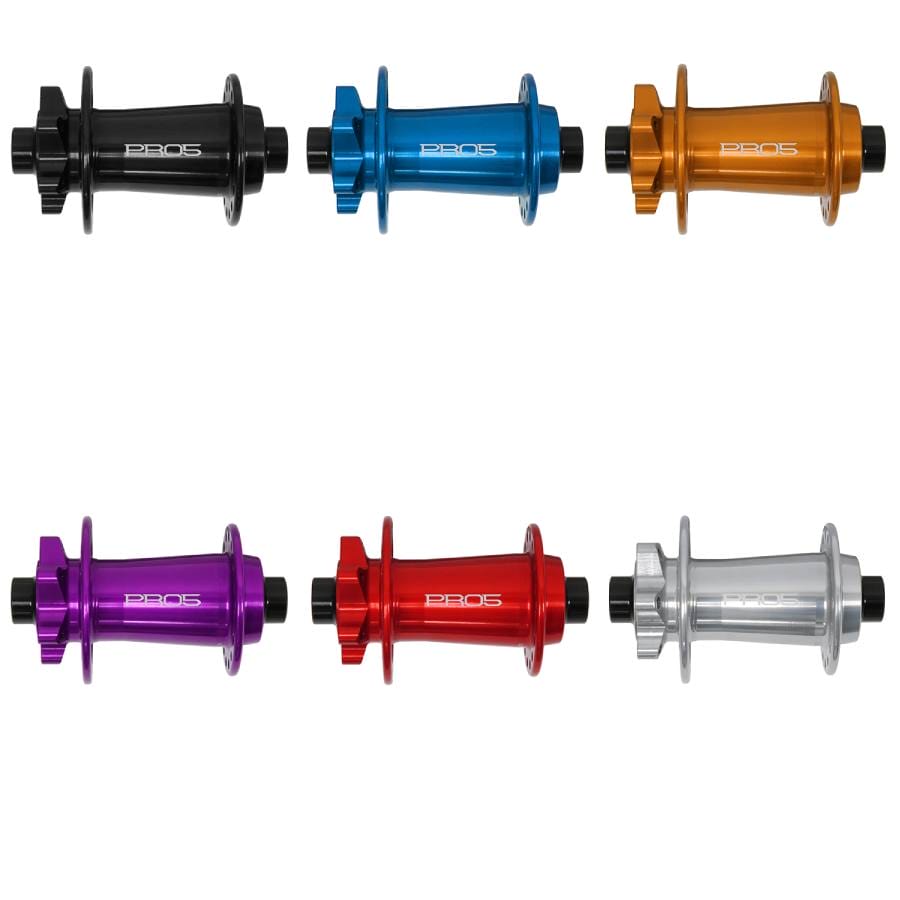
Confirm the exact 28H configuration before ordering
Hope’s current Pro 5 110 mm Boost specification lists 24, 28, 32 and 36-hole drillings and both Centre Lock and 6-bolt shells. That family-level menu is exactly why a listing that says only “Pro 5 front Boost” is incomplete. Before paying, make the seller’s description or invoice identify every field below.
Required for this exact version
- Front, 110 mm Boost shell
- 28-hole J-bend drilling
- ISO 6-bolt rotor mount
- End caps matching the fork axle
Names that are not specific enough
- “Pro 5 front hub”
- “Boost 110 hub”
- “28H Hope hub”
- “Convertible front hub”
110 mm Boost cannot be converted into a 100 mm shell
Hope states that the 110 mm front hub uses a different, wider body and moves its flanges 5 mm outward compared with the standard 100 mm front hub. End caps change the axle interface at each side; they do not narrow the shell, move its flanges inward or change the fork’s dropout spacing.
The official exploded drawing identifies the same 110 mm body, HUB1018-19, with several spacer kits: HUB441 for 15 mm, HUB494 for 20 mm, HUB485 for 15 mm Torque and HUB482 for 12 mm. Those options should not be read as universal conversions. The selected kit still has to be valid for the exact 110 mm fork interface, and Hope notes that 20 mm is available on the 6-bolt hub only.
A Reddit thread from a parent trying to identify the correct Pro 5 hubs shows the practical naming problem: even after identifying “Boost,” the buyer still had to resolve front and rear spacing, axle sizes, brake interface and cassette driver. The thread is not a compatibility authority; it is evidence that abbreviated listings routinely omit purchase-critical details. Use the fork manual and Hope drawing, not a forum answer, to approve the fit.
28 holes is a wheel-system decision
The hub and rim must have the same spoke count. A 28H hub cannot be laced correctly to a 32H rim, and changing lacing pattern does not solve the mismatch. This sounds obvious, yet it is an expensive ordering error: in a wheel-building discussion about a mismatched rim and hub, the poster had already bought a 28-hole rim while owning a 32-hole hub.
Choosing 28 rather than 32 holes does not by itself prove that a wheel is strong enough or too light for a rider. Rim depth and material, spoke model and gauge, lacing, tension, tyre volume, use and builder quality all matter. The defensible rule is to choose the spoke count as part of a complete wheel specification, not from a generic rider-weight threshold.
For the J-bend 110 mm 6-bolt shell, Hope’s February 2025 PCD and flange-offset drawing gives the dimensions a spoke calculator needs:
Disc side
- 58 mm spoke-hole PCD
- 25 mm flange offset
- 2.6 mm spoke-hole diameter
Non-disc side
- 52 mm spoke-hole PCD
- 34 mm flange offset
- 2.6 mm spoke-hole diameter
Those figures are not a spoke-length answer. Accurate length also needs the rim’s effective rim diameter, spoke count, crossing pattern and the calculator’s convention for flange offset and spoke-hole diameter. Reusing a spoke length from another “Boost 110” hub is unsafe because flange geometry can differ even when dropout spacing is identical.
6-bolt fitment: parts, tools and torque
The rotor mount uses six M5 bolts on a 44 mm PCD. Hope’s current brake instructions specify a T25 driver, a cross-pattern tightening sequence and 5–6 N·m for its six-bolt rotor fasteners. The direction arrow on the rotor must point with forward wheel rotation. Those numbers apply to Hope’s documented rotor installation; use another rotor manufacturer’s instructions when its hardware specifies something different.
- Confirm a 6-bolt rotor is available in the required diameter and thickness for the brake.
- Clean the hub and rotor mating faces before assembly.
- Orient the rotor’s direction arrow correctly.
- Start all six M5 bolts by hand, then tighten in a cross pattern with a T25 driver.
- For Hope’s documented hardware, finish at 5–6 N·m with a calibrated torque wrench.
- After installing the wheel, check rotor position in the caliper and verify that it turns without contact.
This shell cannot become Centre Lock with an end cap. If the existing rotor and future wheel plan are Centre Lock, buy the Centre Lock Pro 5 body rather than adding an adapter to the wrong starting point.
Bearing service is simple only with the correct support
The 110 mm exploded drawing shows two S6804 bearings, a HUB1009-13 centre tube and the spacer kits around the HUB1018-19 body. Hope’s 2023 Pro 5 service-tool chart specifies HTT194—the Pro 5 front bearing press tool—on both disc and non-disc sides of every 6-bolt shell width. The chart also states that the tool is included in the HTPRO5 tool kit.
The drawing and tool sheet do not publish a bearing-press torque. Bearing installation is controlled by alignment, correct support and seating—not by inventing a Newton-metre target. Likewise, the fork thru-axle torque comes from the fork or bicycle manufacturer because the axle is not supplied or governed by the hub shell.
What the front hub does—and does not—change
The Pro 5 name is strongly associated with 108-point engagement, pawls, sound and the revised rear freehub. None of those rear-hub features exists in this front hub. Buying this component will not reduce crank pickup angle or create the familiar Hope freewheel sound.
The relevant design claims are the forged 2014-T6 aluminium shell, stainless cartridge bearings and wider flange placement. Hope says the 5 mm outboard flange movement and larger spoke flange enable a stiffer wheel build. That is a manufacturer claim about geometry; the finished wheel’s stiffness and durability still depend on rim, spokes, tension and build quality.
If the decision is actually about rear-hub engagement, driver bodies or e-bike versions, use the Pro 5 versus Pro 4 comparison. For a matching Boost rear build, the 148 mm rear-hub guide covers the cassette and drive-side choices this front page intentionally excludes.
Is it worth the money? Price the completed wheel
As checked on 8 September 2026, Hope lists the 110 mm Boost front family at £100, €125.60 or $130.81 excluding tax. It is worth considering at that price when it completes an already-specified 28H, J-bend, 6-bolt wheel and its documented service parts matter to you. It is poor value when buying it forces a rim, rotor or spoke change that the correct hub variant would avoid.
The installed cost can include a compatible 28H rim, 28 correctly sized spokes and nipples, wheel-building labour, rim tape, a rotor change and—if the old wheel is being dismantled—an honest decision about whether any spokes are suitable for reuse. Compare completed-wheel cost, not hub MSRP alone.
This version makes sense when
- The fork and end caps are a confirmed 110 mm Boost match.
- The chosen rim is 28H.
- The wheel plan calls for J-bend spokes.
- A 6-bolt rotor is already part of the brake specification.
- The builder has calculated spoke length from the current Hope drawing.
Choose another version when
- The fork shell spacing is 100 mm.
- The rim is 24H, 32H or 36H.
- The wheel must use Centre Lock.
- The build requires straight-pull or Berd hook-flange spokes.
- The axle conversion is not explicitly supported for the selected shell.
The evidence supports this hub as a precise component for a planned custom wheel, not as a universal front-wheel upgrade. Its strongest advantages are the documented flange geometry, replaceable cartridge bearings, multiple supported axle interfaces and continuing parts documentation. Its main risk is ordering from a shortened product name that hides the shell, rotor, drilling or end-cap choice.