GEAR REVIEW

Hope Tech 4 V4 Brake Review: Power, Setup Notes, and Who Should Buy It

HOMETOWN • HomeTown Bikes • July 3, 2026

The Hope Tech 4 V4 is not the brake I would point at every trail rider first. It is the big-power option in Hope’s mountain-bike brake range: the one that starts to make sense when weight, speed, heat, e-bike load, bike-park laps, or long descents are already pushing smaller brakes hard.

That is the useful way to judge it. The V4 is not just a shiny upgrade because it comes in nice colors. It is a powerful four-piston brake with a large caliper, wide rotor compatibility, real adjustment at the lever, and a setup process that rewards careful alignment and a good bleed. If you want a light, simple, quiet trail brake, this may be more brake than you need. If you want power you can tune and service, it becomes much more interesting.

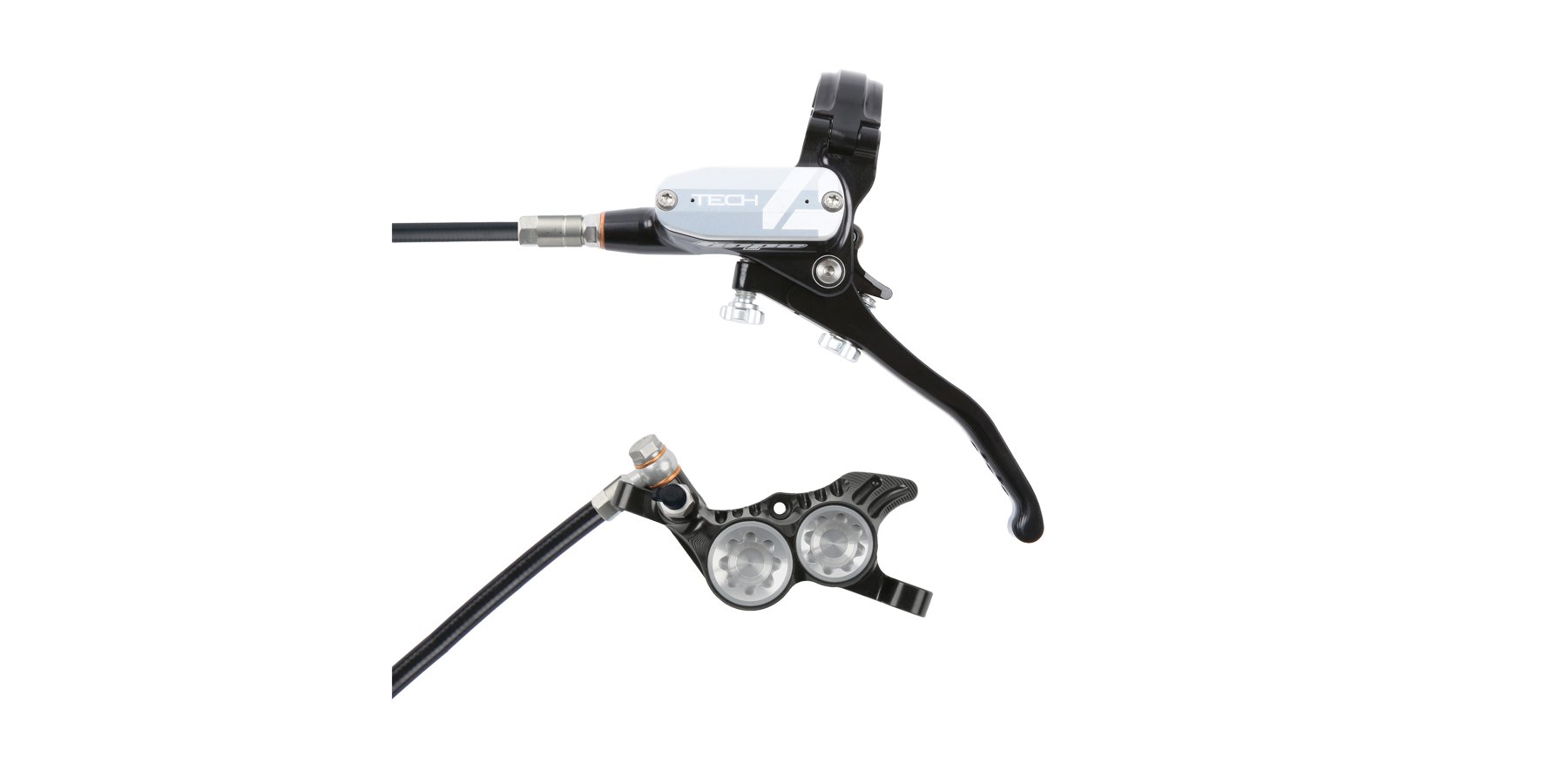
Hope Tech 4 V4 brake with black lever and silver accents
The Hope Tech 4 V4 is the heavy-duty option in the Tech 4 family: strong lever adjustment, a large V4 caliper, and compatibility with thicker rotor setups.

Quick verdict

The Hope Tech 4 V4 makes the most sense for aggressive enduro, downhill, bike-park, heavy-rider, tandem, and e-MTB use. It is powerful, highly serviceable, and easy to tune at the lever, but it is not the cheapest or lowest-fuss brake. The main things to check before buying are frame/fork clearance, rotor choice, pad compound, and whether you actually need V4-level power.

Hope positions the V4 as its high-power option for enduro, downhill, tandems, and e-bikes in its own braking guide, while the E4 sits closer to trail and all-mountain use. That distinction matters because plenty of riders would be better served by E4-level power unless they are already finding their current brakes underpowered or heat-limited.

Key specs and fitment details

Hope’s Tech 4 V4 product page lists the main details that separate this brake from a normal trail brake: tool-free reach and bite-point adjustment, a one-piece CNC caliper, hybrid pistons, standard or braided hose options, color accent choices, and a stated 30 percent pressure increase compared with the older Tech 3 brake.

Brake type Hydraulic disc brake for gravity, enduro, heavy-duty MTB, e-bike, and similar high-load use
Lever adjustments Tool-free reach and bite point adjustment
Caliper V4 one-piece CNC four-piston caliper with hybrid-style pistons
Fluid DOT brake fluid system
Rotor note Hope lists maximum rotor thickness with the V4 caliper as 3.3 mm
Hose options Standard black hose or braided hose, depending on version
Color options Black or silver body with multiple accent-color options
Main caution Check direct-mount fork/frame clearance and correct brake mount choice before buying

Who should choose the V4?

Choose the Tech 4 V4 if your current brakes feel short on power during long descents, if you are on a heavier e-MTB, if you ride bike parks or downhill tracks, or if you want a brake that can be rebuilt and kept alive with spares rather than treated as disposable.

The V4 is also attractive if you like a progressive brake rather than an instant on/off feel. Rider discussions often describe the Hope feel as strong but controllable rather than grabby. That is not the same as saying every rider will love the lever shape or stroke, but it explains why the V4 has a loyal following among riders who care about modulation.

Who should skip it?

Skip it if your riding is mostly light trail, short local loops, or XC-style use where weight, simplicity, and quiet operation matter more than maximum heat capacity. Also skip it if your frame or fork has tight brake clearance and you cannot confirm fitment before buying.

Hope specifically notes that the V4 caliper is not compatible with all direct-mount 180 mm forks because of the large piston design and variation in mount positions. Hope recommends the correct mount and a 200 mm rotor for that kind of application. That is not a small-print detail; it is the kind of fitment note that should be checked before money changes hands.

Setup matters more than the marketing suggests

The V4 is powerful, but it is still a hydraulic brake that depends on a clean bleed, centered caliper, healthy pads, and the right rotor. Hope’s own braking guide tells riders to follow the manual, pay attention to torque settings, and align the rotor centrally in the caliper. That sounds basic, but it is especially relevant here because the V4 caliper is large and the pad/rotor setup is part of why the brake works.

If you are servicing Tech 4 brakes yourself, the dedicated process and fittings matter. We covered that separately in the Hope Tech 4 Easy Brake Bleed Kit review, but the short version is simple: do not judge the V4 from a lazy bleed or rushed caliper setup.

Hope Tech 4 V4 lever with reach and bite point adjustment dials
The Tech 4 lever gives tool-free reach and bite-point adjustment. Those two settings can interact, so expect to fine-tune both rather than turning one dial once and calling it done.

Reach and bite point: useful, but not magic

The reach dial changes where the lever sits relative to the bar. The bite-point dial changes where the pads start to engage in the lever stroke. In practice, riders often adjust both together because moving one setting can change how the other feels.

A rider discussion on Reddit about Tech 4 V4 reach and bite-point feel is useful because it shows where some confusion comes from: a rider wanted the lever closer to the bar but still wanted a firm early bite. Treat that as anecdotal discussion, not a setup manual, but it is a good reminder that the V4 has its own lever feel. If you like ultra-short throw with the blade very close to the grip, test before buying if possible.

Rotor choice: normal, heavy-duty, or vented?

The V4 caliper can work with thicker rotor setups, and Hope lists 3.3 mm as the maximum rotor thickness for the V4 caliper. That does not mean every V4 buyer should automatically choose a vented rotor. A thick or vented rotor can help with heat, stiffness, and consistency, but it also adds weight and can create clearance questions.

For more detail on Hope’s 3.3 mm vented disc, read our Hope V4 Vented Rotor review. The practical answer is that vented rotors make more sense for downhill, e-bike, tandem, and repeated high-heat use than for ordinary trail riding.

What riders report in the real world

A long SingletrackWorld rider thread about Tech 4 V4 brakes gives a more useful picture than a spec sheet alone. Some riders praise the power, modulation, and meaningful adjustment. Others mention noise, especially with certain pad and weather combinations, and one rider points out that vented rotors may be overkill for normal trail riding.

That mixed feedback is exactly what I would expect from a powerful, metal-bodied, highly adjustable brake. The good reports are very good: strong power, consistent feel, and serviceable hardware. The complaints are also believable: pad noise, setup sensitivity, and the need to choose the right rotor/pad setup instead of treating the brake as plug-and-play.

How it sits next to newer Hope brakes

The newer Hope EVO GR4 changes the buying decision because it is Hope’s current maximum-power gravity brake. That does not make the V4 irrelevant, especially for riders who already like the V4 platform or are building around V4-compatible parts.

For the complete power, lever-feel, bleeding and rotor comparison, read our Hope EVO GR4 vs Tech 4 V4 guide.

Pros and cons

  • Pros: very strong braking potential, excellent parts support, tool-free reach and bite-point adjustment, serviceable construction, color options, and thick-rotor compatibility.
  • Cons: expensive, not the lightest choice, can be noisy depending on pad/rotor/weather setup, needs careful bleed and caliper alignment, and may have clearance limits on some frames or forks.

Bottom line

The Hope Tech 4 V4 is a serious brake for riders who can use serious braking power. It is not the neatest answer for every trail bike, and it is not the cheapest way to get four pistons. But for enduro, downhill, e-bike, heavy-rider, tandem, or repeated long-descent use, the V4 still makes sense because it combines power, modulation, serviceability, and real setup adjustment.

The main warning is to buy it for the right reason. Do not buy the V4 only because it looks good. Buy it because your riding asks for more heat control, more power, or a brake you can tune and maintain carefully.

FAQ

Is the Hope Tech 4 V4 too much brake for trail riding?

For many trail riders, yes. It can work on a trail bike, but the V4 is most convincing when the riding is steep, fast, heavy, or heat-heavy enough to justify the extra power and setup attention.

Does the Tech 4 V4 need Hope rotors?

Use a rotor that matches the brake, mount, thickness, frame clearance, and riding need. Hope’s V4 caliper can accept thicker rotor setups, but you still need to check rotor thickness, diameter, mount, and clearance before fitting parts.

Is the V4 better than the E4?

It depends on the bike and rider. E4 is usually the more sensible trail/all-mountain option. V4 is the stronger choice for downhill, enduro, e-bike, tandem, heavy riders, or anyone already asking too much from smaller brakes.

Are noisy pads a common issue?

Rider feedback is mixed. Some riders report quiet, consistent braking; others mention squeal or chirping with certain pad, rotor, and wet-weather combinations. Treat noise as a setup and compound question, not a guaranteed fault or guaranteed non-issue.

Should I choose Tech 4 V4 or EVO GR4?

Choose Tech 4 V4 if you want the established V4 platform and possible vented-rotor route. Look at EVO GR4 if you want Hope’s newer maximum-power gravity brake and do not need vented rotor compatibility.