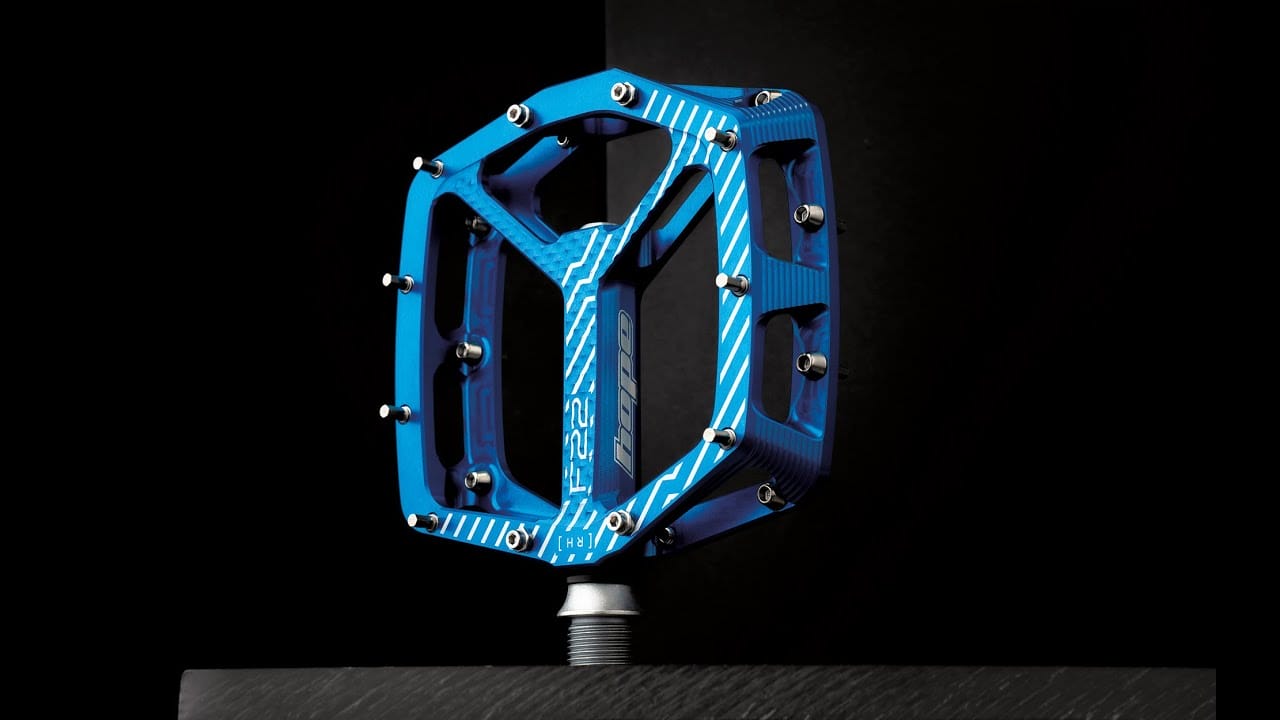
Choose by how you want your shoe held to the pedal: flat or clipless. Hope’s current range has the F22 flat pedal and three Union clipless models—RC, TC and GC. All three Unions use Hope cleats, not Shimano SPD cleats; that cleat change is the first compatibility check, before colour, weight or platform size.
HometownBikes has not ridden these pedals. Where ride feel matters to the choice, the account below is attributed to the tester or rider who reported it.
Choose the shoe-to-pedal interface first
| Your priority | Start here | Decision that can rule it out |
|---|---|---|
| Move your foot freely and use flat shoes | F22 flat pedal | Your shoe sole and pin setup must give the grip you need; pedal branding cannot make a hard or worn sole stick. |
| Clip in, with the smallest Union body | Union RC | Hope’s own cleats are required; the RC has no pedal pins in the box. |
| Clip in but retain more shoe support | Union TC | Allow for Hope cleats and check tread, cleat depth and pin clearance on your exact shoes. |
| Clip in with the largest Union support surface | Union GC | The bigger platform and optional pins or foot plates still need to clear and suit your shoe sole. |
If you are changing from flats to clipless because a foot keeps slipping, stop and decide whether you want cleat retention or a better-matched flat shoe and platform. Those solve different problems. A clipless pedal also brings a cleat standard, shoe setup and release motion into the decision.
F22 or F20: current flat pedal versus the older platform
Hope’s current catalogue lists the F22 as its adult flat pedal; the F20 is mainly relevant to current owners and used buyers. Hope says the F22 carries over the F20’s internal layout but changes the platform and axle. The pedal platform is CNC-machined in Barnoldswick, UK (F22 specifications); Hope says it makes virtually all of its products in-house at that factory (factory overview). Hope lists the F22 at 360 g per pair, with three cartridge bearings, an IGUS bush, adjustable reverse-loading pins and rebuildable internals. These are manufacturer specifications and claims.
The decision over an F20 is whether its existing platform still suits your shoes and whether the pedals need parts or service—not whether every older set needs replacing. The F22 changes the platform shape and pin arrangement; it does not make grip independent of shoe rubber and tread. See our F22/F20 comparison for the generation details, or the F22 review for the current model.
RC, TC or GC: pick the Union platform around the shoe
All three Unions use Hope’s proprietary cleat system. “SPD-style” describes a broad two-bolt shoe format, not cleat interchangeability: Shimano SPD cleats are not a substitute for Hope Union cleats. Hope describes the RC as the small-platform race option, TC as the trail platform, and GC as the gravity platform with the largest contact area and optional foot plates. TC offers up to four pins per side; GC can take up to seven per side or its supplied plates. Hope lists a 55 mm Q-factor across the Union range.
RC is the compact Union option, TC adds a trail platform, and GC provides the largest platform and optional foot plates. Hope describes the models by those uses, not by rider weight or a shoe-size threshold. In one GC-versus-TC rider thread, a commenter used shoe size to make the choice; that is an individual heuristic, not a fit rule.
Hope includes No. 4 cleats (4° float, 12° release angle) and No. 5 cleats (5° float, 13° release angle), with 2 mm lateral float for both. A 2022 BikeRadar TC test reported smooth release but firmer clip-in effort than comparable SPD or Crankbrothers pedals at the tester’s chosen setting. That one test is a reason to try the action yourself if easy re-entry is a priority. Our Union guide has the model-specific details.
Check the cleat against your actual shoe
Hope’s Union instructions make shoe setup part of the system. The cleat-to-sole drop varies between shoe makers and even between models, so use the supplied gauge and choose the shim for that shoe rather than copying a setting from another pair. The manual gives these ranges: under 6.75 mm, no shim; 6.75–7.25 mm, no shim; 7.25–7.75 mm, 0.5 mm; and 7.75–8.25 mm, 1 mm. At a boundary, follow the gauge’s illustrated contact condition rather than relying on a rounded measurement alone.
Then check the sole against the pedal. Hope specifies that the rear pins should contact the shoe and the front pins should retain at least 2 mm clearance. A sole that is too close can restrict engagement; pins set too high at the rear can obstruct heel rotation and make release difficult. On a GC, decide whether the supplied foot plates or pins give the better interface. If you change shoes, repeat the check: the same cleat and shim combination is not automatically correct for a different sole.
What you can service
Hope lists three cartridge bearings and an IGUS bush and describes both F22 and Union pedals as rebuildable. There is a limit: Hope’s Union parts diagram says the clip mechanism is not separately user-serviceable and that it can be serviced by Hope. Check the exact model’s parts diagram before assuming a rebuild means every component is available for home repair. Our pin and service guide covers the maintenance details.
For the Union, the non-standard cleat is the main ownership trade-off: if your other bikes use SPD, you will need Hope cleats and spares for this setup. Independent testers have also noted the premium price alongside the machined construction; see Pinkbike’s TC review. Check a current local price rather than using launch-era review prices.
Choose the F22 if you want Hope flats; keep or repair an F20 if its platform still works for you. Choose Union only if you are comfortable switching to Hope cleats, then select RC for the compact body, TC for a trail platform, or GC for the largest support area. If Shimano SPD cleat interchange is a must, Union is the wrong system.