Hope XCR Pro E4 Review: Lightweight Trail Power Without the Tech 4 Lever
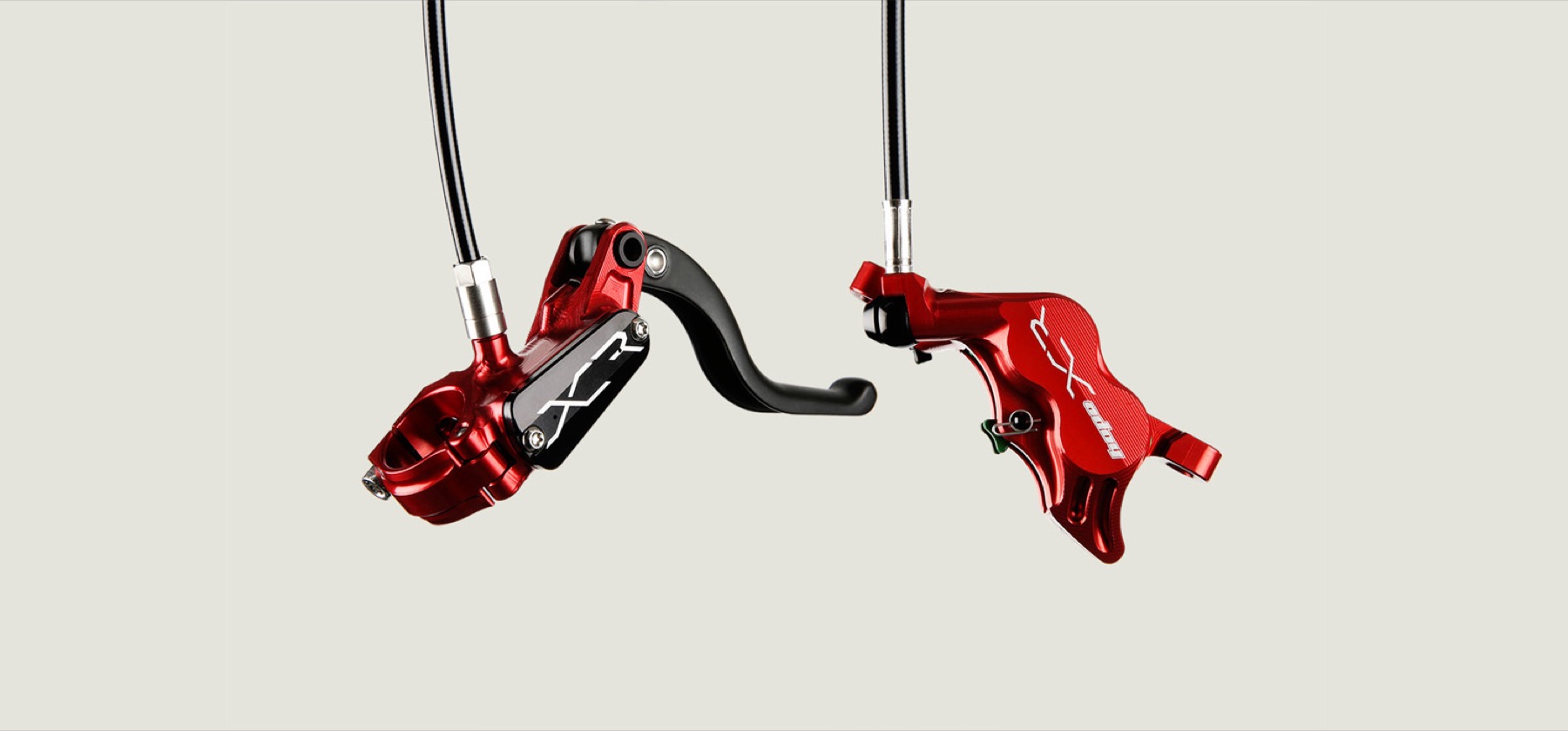
The Hope XCR Pro E4 is for riders who want a lighter trail brake without dropping back to a small two-piston setup. It pairs Hope’s slim XCR Pro lever with the four-piston E4 caliper, which makes it a different kind of brake from the Tech 4 E4 or the newer EVO TR4. The idea is simple: keep weight and cockpit bulk down, but still get real trail-bike stopping power.
That puts the XCR Pro E4 in a useful but specific place. It is not the maximum-power Hope brake, and it is not the lightest Hope brake either. It is the middle answer for downcountry, fast trail, short-travel trail bikes, and riders who want E4-caliper control without the heavier Tech 4 lever hardware.
Quick verdict
The Hope XCR Pro E4 makes the most sense for downcountry and trail riders who care about weight but still want a proper four-piston brake. It is a strong candidate for short-travel trail bikes, aggressive XC bikes, and riders who find two-piston brakes marginal but do not want the size, weight, or extra adjustment of Tech 4 or EVO brakes.
Skip it if you want maximum lever adjustment, bite-point tuning, gravity-bike power, or the newest Hope EVO brake architecture. In that case, the Hope Tech 4 EVO TR4 review or the Hope Tech 4 EVO GR4 review will be more relevant.
What the XCR Pro E4 is meant to do
Hope’s XCR Pro E4 product page describes the brake as a lightweight trail/downcountry setup, using a carbon lever blade, titanium hardware, and the E4 postmount caliper. Hope lists the claimed weight without fluid as 236 g for the E4 version.
The important part is the lever/caliper pairing. The XCR Pro lever is simpler and lighter than the Tech 4 lever. The E4 caliper gives more braking support than the X2 caliper. That combination is why the XCR Pro E4 exists: it is for riders who want enough brake for fast trail riding without turning the bike into a full enduro build.
Key specs and fitment details
| Brake type | Hydraulic disc brake for downcountry, fast XC, and trail use |
|---|---|
| Lever | XCR Pro lever with carbon blade, titanium hardware, and reach adjustment |
| Caliper | E4 postmount four-piston caliper |
| Claimed weight | Hope lists 236 g without fluid for the E4 version |
| Hose | Black hose only, according to Hope’s product page |
| Pads | Green Race pads for E4 |
| Mounting | Postmount caliper; check frame/fork mount and rotor size before buying |
| Main caution | No Tech 4-style bite-point dial, and not intended as Hope’s gravity-power brake |
Who should choose the XCR Pro E4?
Choose the XCR Pro E4 if your riding sits between XC and harder trail riding. That means short-travel trail bikes, downcountry bikes, lightweight builds that still see real descents, and riders who want more confidence than a two-piston brake gives without accepting the bulk of a larger trail/enduro brake.
It also makes sense if you like Hope’s serviceability and lever feel but want a cleaner cockpit. The hinge clamp helps installation, the lever has reach adjustment, and Hope says the XCR Pro lever has a 10 percent power increase over the older Race Evo lever. It is a light brake, but it is not a race-only brake.
Who should skip it?
Skip it if you want a brake for repeated long descents, bike-park laps, heavy e-bike use, or aggressive enduro riding. The XCR Pro E4 has a four-piston caliper, but the rest of the package is still built around a lightweight lever and downcountry/trail intent. If the bike is heavy or the descents are long, buy a brake designed for that job.
Also skip it if you want the most adjustable Hope lever. The XCR Pro lever gives reach adjustment, but it does not give the same adjustment range and bite-point control story as Tech 4 or EVO. If you want to fine-tune the lever in more detail, that alone may push you toward Tech 4 or EVO.
XCR Pro E4 vs XCR Pro X2
This is the most natural comparison. XCR Pro X2 is the lighter two-piston option. XCR Pro E4 adds the four-piston E4 caliper for riders who want more bite, more support, and more heat capacity. If your bike is mostly XC and you rarely feel underbraked, X2 is probably enough. If your bike is getting faster, tires are getting grippier, or descents are getting rougher, E4 becomes more interesting.
A rider discussion on SingletrackWorld about X2 or E4 for light trail use shows the buyer dilemma clearly, even though it predates the current XCR Pro E4 package. Riders are often not asking whether E4 works. They are asking whether the extra power is worth the weight and whether a lighter bike really needs it.
XCR Pro E4 vs Tech 4 E4
The Tech 4 E4 gives you the more substantial Tech 4 lever with tool-free reach and bite-point adjustment. XCR Pro E4 gives you the lighter, simpler XCR Pro lever with the E4 caliper. So the choice is not just power; it is lever feel, adjustment, weight, cockpit preference, and how much tuning you want at the bar.
If your priority is lower weight and a cleaner lever, XCR Pro E4 is the more focused choice. If your priority is adjustment range, bite-point tuning, and a more powerful lever platform, Tech 4 E4 or the newer EVO TR4 deserves the closer look.
XCR Pro E4 vs EVO TR4
The EVO TR4 is Hope’s newer four-piston trail brake. It is not simply an XCR Pro E4 replacement because the design priorities are different. TR4 is more about trail braking performance and the latest EVO lever/caliper updates. XCR Pro E4 is more about light weight and downcountry/trail simplicity.
That makes the decision fairly practical. Choose XCR Pro E4 for a lighter bike where weight and cockpit feel matter. Choose EVO TR4 if you want a newer, more substantial trail brake with the EVO lever features and do not mind the extra weight or cost.
Rotor choice and setup notes
Do not treat rotor size as an afterthought. A lighter brake on a short-travel bike can feel very different with 160 mm, 180 mm, or larger rotors, depending on rider weight, tire grip, terrain, and heat. Check the frame and fork maximum rotor size, then choose the rotor that matches the riding rather than the lightest number on paper.
Setup still matters. A clean DOT-fluid bleed, correctly centered caliper, proper pad bed-in, and compatible rotor are all part of the result. If you are doing the service at home, the Hope Tech 4 Easy Brake Bleed Kit review is relevant because Hope’s current brake service process rewards using the correct fittings and taking the bleed seriously.
What riders tend to care about
With Hope E4-style brakes, the rider feedback theme is usually not just raw power. It is modulation, lever feel, serviceability, and whether the brake feels progressive rather than grabby. An older Pinkbike discussion about Hope E4 brakes includes exactly that kind of rider comparison: plenty of power, but a more progressive feel than some sharper-biting alternatives. Treat that as older E4-family feedback, not a specific XCR Pro E4 lab test.
That distinction matters because the XCR Pro E4 is a hybrid of priorities. If you only care about maximum power, it is not the correct Hope brake. If you care about a light lever, clean modulation, four-piston support, and enough brake for a fast trail bike, the logic becomes much stronger.
Pros and cons
- Pros: light for a four-piston trail brake, carbon lever blade, titanium hardware, E4 caliper power, reach adjustment, hinge clamp, serviceable Hope construction, and a clear downcountry/trail role.
- Cons: no Tech 4 bite-point dial, black hose only, not a gravity brake, still expensive, and riders on heavier or harder-ridden bikes may outgrow it quickly.
Bottom line
The Hope XCR Pro E4 is a good answer for a specific rider: someone building a fast trail or downcountry bike who wants more brake than an X2 but does not want a full Tech 4 or EVO setup. It is not the obvious choice for every mountain bike, and that is fine.
If your riding is light, choose X2. If your riding is hard and heavy, choose TR4, GR4, or another stronger trail/enduro brake. If your bike sits in the middle and you care about weight as much as power, the XCR Pro E4 is one of the more interesting Hope options.
FAQ
Is the Hope XCR Pro E4 a trail brake or an XC brake?
It sits between the two. Hope describes it as a lightweight trail/downcountry brake. Think aggressive XC, downcountry, and fast trail rather than downhill or enduro.
Is XCR Pro E4 stronger than XCR Pro X2?
Yes, the E4 version uses a four-piston E4 caliper, while X2 is the lighter two-piston option. E4 is the better choice when you want more support and heat capacity.
Does the XCR Pro E4 have bite-point adjustment?
No. The XCR Pro lever has reach adjustment, but it does not have the same Tech 4-style bite-point dial. If that adjustment is important, look at Tech 4 or EVO options.
Is it good for e-MTB use?
Usually, I would not start here for e-MTB use. A heavier e-bike generally suits a stronger trail/enduro brake such as EVO TR4 or EVO GR4 better.
What rotor size should I use?
Use the largest rotor size that makes sense for your frame, fork, riding, and weight, without exceeding manufacturer limits. Many trail riders will look at 180 mm as a sensible starting point, but the right answer depends on the bike and terrain.